

5 Vertical Garden Ideas for Small Balconies
Table of Contents
- Why Vertical Gardens Transform Small Balconies
- Best Plants for Vertical Balcony Gardens
- Idea 1: Railing Planters for Instant Greenery Without Floor Space
- Idea 2: Wall-Mounted Trellises and Living Walls
- Idea 3: Tiered Plant Stands for Multi-Level Displays
- Idea 4: DIY Vertical Garden Structures for Apartments
- Idea 5: Self-Watering and Smart Vertical Systems
- Vertical Garden Maintenance Tips for Busy Households
- Frequently Asked Questions
Last Updated: September 17, 2026
Why Vertical Gardens Transform Small Balconies
A balcony with no floor space left isn't a dead end, it's a wall waiting to be planted. Vertical garden ideas solve the problem that stops most small-balcony growers: horizontal space runs out fast, but vertical space sits unused. This guide from Viva homeStore walks through five setups that work on real balconies, from renter-friendly railing planters to self-watering systems.
Best Plants for Vertical Balcony Gardens
The best plants for vertical balcony gardens are compact, shallow-rooted, and matched to your light exposure. Get that combination right and almost everything else takes care of itself.
Herbs and Leafy Greens That Thrive in Tight Spaces
Herbs are the easiest starting point for a vertical setup. Basil, mint, chives, parsley, and thyme all handle confined root zones well:
- Basil wants full sun and at least six inches of depth. Pinch the top set of leaves every couple of weeks to keep it bushy instead of leggy.
- Mint is the exception to almost every rule, it tolerates partial shade and shallow pockets, but it spreads aggressively. Keep it in its own pocket rather than sharing with neighbors.
- Chives and thyme are the most forgiving for beginners. Both are drought-tolerant once established and bounce back from a missed watering.
- Parsley is slower to germinate but produces for months in partial shade.
Flowers and Trailing Plants for Aesthetic Appeal
Trailing plants turn a plain wall into something worth looking at. Creeping thyme, trailing ivy, petunias, and nasturtium spill downward and fill the gaps between pockets. For partial shade, try impatiens or bacopa; for full sun, calibrachoa and portulaca beat petunias in a heat wave.
Idea 1: Railing Planters for Instant Greenery Without Floor Space
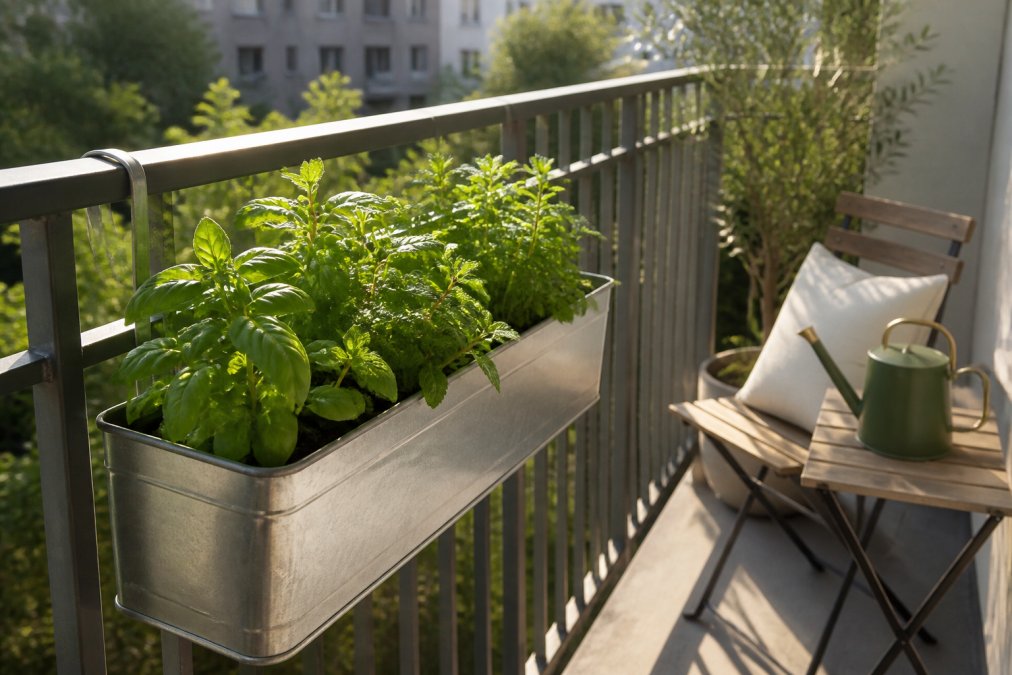
Railing planters are the fastest way to add greenery to a balcony because they use space you already have. No drilling, no floor footprint, no landlord conversation. Brackets clamp onto the railing and you're done in under ten minutes.
Idea 2: Wall-Mounted Trellises and Living Walls
The trade-off is mounting. Trellises and pocket systems need anchors, and renters may not be permitted to drill. Freestanding trellis frames exist for exactly this reason, though they cost more and take up a sliver of floor.
Idea 3: Tiered Plant Stands for Multi-Level Displays
Tiered plant stands are the simplest vertical solution and the one most people should start with. A three-tier unit holds a dozen pots in the footprint of a single chair, with no wall damage.
| Setup | Space Used | Install Effort | Best For |
|---|---|---|---|
| Railing planter | Railing only | Minutes | Renters, herbs |
| Wall trellis or living wall | Wall surface | Moderate | High plant counts |
| Tiered stand | Small floor area | Minutes | Mixed collections |
| DIY pallet or crate | Wall or floor | Weekend project | Budget builds |
| Self-watering system | Small floor area | Minutes | Frequent travelers |
Idea 4: DIY Vertical Garden Structures for Apartments
DIY vertical garden structures for apartments are the budget route, and they're often the most satisfying. You're building around your specific balcony instead of adapting a store-bought unit to it.
Pallet and Crate Setups for Renters
A wooden pallet stood on its edge becomes a five-shelf planter with outdoor sealant and a fabric liner behind each slat. Stacked, screwed-together crates achieve the same with less prep.
Hanging Pocket Systems and Overhead Bars
Pros: Cheapest route, fully customizable, uses overhead space. Cons: Weekend of work, and structural mounting is required for hanging setups.
Idea 5: Self-Watering and Smart Vertical Systems
Self-watering and smart vertical systems are the answer for anyone who travels, works long hours, or simply forgets. A reservoir at the base feeds plants for days, and some units add automated lighting and app monitoring.
Vertical Garden Maintenance Tips for Busy Households
Vertical garden maintenance tips come down to a short weekly routine, not daily fussing. Fifteen minutes once a week keeps almost any vertical system healthy, but water behaves differently on a wall, light hits unevenly, and weight loads shift as plants grow. This routine targets the three things that actually go wrong.
The Weekly Routine
- Water deeply, checking the top and bottom tiers separately, since upper levels dry first
- Rotate pots a quarter turn so all sides get light
- Pinch off dead leaves and spent flowers to keep airflow moving
- Check brackets, anchors, and shelf connections for loosening
- Refill reservoirs and clear any blocked drainage holes
- Feed with a diluted liquid fertilizer every two to three weeks during growing season
Why Vertical Watering Fails (and How to Fix It)
Two problems cause most vertical garden failures: uneven watering, where the top tier dries out while the bottom stays soaked, and overcrowding, which traps moisture against leaves and invites mildew.
Seasonal Adjustments
Watering frequency is not a fixed number. In peak summer, a sun-facing fabric wall may need water twice a day; in spring and fall, once every two or three days. In winter, most herbs and greens can go a week or more between waterings, overwatering in cool weather kills more plants than underwatering.
Structural Checks Most People Skip
Weight is the maintenance item nobody thinks about until something fails. A pocket system loaded with wet soil and mature plants can weigh several times what it did on planting day. Once a month, tug each bracket and anchor and tighten anything that moves. On railing planters, check the clamp bolts, which loosen with temperature swings. On hanging setups, inspect the hook and the pot's own hanger, the failure point is usually the pot, not the anchor.
A Simple Troubleshooting Table
| Symptom | Likely Cause | Fix |
|---|---|---|
| Top tier wilting while bottom is fine | Uneven watering | Two-pass watering; add moss liner to top pockets |
| Yellowing lower leaves | Overwatering or poor drainage | Clear drainage holes; reduce frequency |
| White powder on leaves | Mildew from trapped moisture | Thin plants; improve airflow; water at soil level |
| Plants leaning toward one side | Uneven light | Rotate pots a quarter turn weekly |
| Bracket or anchor loosening | Weight load + temperature swings | Re-tighten monthly; check after storms |
Space plants so air moves between them. If leaves stay wet for hours after watering, thin the planting out.
Frequently Asked Questions
What kind of garden can I create on a small balcony?
A small balcony can host a productive vertical garden using railing planters, wall-mounted trellises, tiered stands, and hanging systems. Focus on compact crops like herbs, lettuce, strawberries, and determinate tomatoes. These vertical garden ideas for small balconies maximize square footage without crowding the floor. Choose lightweight containers and lightweight potting mix to avoid overloading railings. With proper drainage and sunlight, even a 4-foot-wide balcony can yield fresh produce and visual appeal.
Which plants are best for vertical balcony gardens?
The best plants for vertical balcony gardens include herbs (basil, mint, parsley, thyme), leafy greens (lettuce, spinach, kale), compact peppers, and trailing flowers like petunias or nasturtiums. These plants have shallow root systems and thrive in containers. For edible gardens, mix herbs with cherry tomatoes and strawberries. In partial shade, try chard or mint. Avoid large vining plants like pumpkins unless you have a sturdy trellis. Match plants to your balcony's sunlight hours: 6+ hours for fruiting crops, 3-4 hours for leafy greens.
What are common vertical garden mistakes?
Common mistakes include overcrowding plants, using heavy soil that dries out slowly, ignoring weight limits on railings, and placing sun-loving plants in shade. Another error is skipping drainage, which leads to root rot. Many people also forget to secure structures against wind, especially on upper floors. Finally, inconsistent watering kills more vertical gardens than pests. Group plants by water needs and set a simple routine. Lightweight fabric pockets dry faster, so check them daily during heat waves.
How do you maintain a vertical garden on a balcony?
Vertical garden maintenance tips for busy households: water deeply every 1-2 days in summer, less in cool weather. Rotate plants weekly so all sides get sun. Feed with a liquid fertilizer every two weeks during growing season. Prune dead leaves and spent blooms to reduce visual clutter and prevent pests. Check for spider mites and aphids weekly. Before winter, move tender perennials indoors or replace with cold-hardy greens. Clean drip trays monthly to avoid stains and mold on your balcony floor.
How to style a very small balcony?
Style a very small balcony by choosing a neutral color palette for containers and furniture, then letting plant textures provide contrast. Use vertical garden ideas for small balconies to draw the eye upward, freeing floor space for a small bistro set or a folding chair. Add ambient lighting like solar string lights or a clip-on lantern for evening use. Keep decor embellishments minimal: one statement piece, such as a tiered stand or a living wall, is enough. A clutter-free layout makes the balcony feel larger and more inviting.
Small balconies punish ambition. The people who succeed with vertical gardens aren't the ones who plant the most, they're the ones who pick one system that fits their light, their lease, and their schedule, then keep it alive. Viva homeStore carries the practical home essentials that make that easier, including space-saving storage, functional lighting, and furniture built for compact living. Browse the collection and build a balcony that works for the space you actually have.