

Best Commercial Grade Durable Storage Totes for 2026
Table of Contents
- What Makes a Storage Tote Commercial Grade
- Heavy-Duty Storage Bins: Materials That Matter
- Industrial Storage Totes: Capacity, Stackability, and Design
- Heavy-Duty Plastic Attached-Lid Totes: Security and Durability
- 27-Gallon Storage Totes: The Workhorse Size for Commercial Use
- Top Commercial Grade Durable Storage Totes Compared
- How to Choose the Right Commercial Grade Durable Storage Tote
- Durability Testing: What Separates Premium Totes from Standard Bins
- Frequently Asked Questions
Last Updated: October 6, 2026

What Makes a Storage Tote Commercial Grade
Commercial grade durable storage totes handle conditions standard household containers can't: reinforced construction, heavier-gauge plastic, and design engineered for repeated handling, stacking, and harsh environments.
Commercial-grade totes use industrial-strength materials like high-density polyethylene (HDPE) or polypropylene that resist impact, chemicals, grease, moisture, and temperature extremes. Household containers use thinner plastic that cracks under load or degrades from oils, solvents, or UV light.
Understanding what separates commercial-grade totes from standard bins is essential before you buy.
Three factors separate them: material thickness, load capacity, and closure design. A commercial tote handles 50+ pounds stacked six high; a standard bin maxes out at 20-30 pounds before bowing or cracking. For workshops, warehouses, and automotive shops moving heavy items daily, that gap decides whether storage pays for itself or becomes a recurring expense.
Heavy-Duty Storage Bins: Materials That Matter
Material selection is the foundation of durability. The best commercial-grade storage bins use one of three core plastics, each with distinct advantages.
High-Density Polyethylene (HDPE) is the workhorse. It resists most oils, solvents, and chemicals, ideal for automotive shops, manufacturing facilities, and workshops, and handles temperature swings from below freezing to 120°F without becoming brittle or warping. The tradeoff is cost.
Polypropylene is lighter than HDPE, still chemical-resistant, and more affordable. It suits food-grade storage, parts organization, and indoor warehouse use, but is less suitable for extreme cold or outdoor UV exposure.
Fiberglass-reinforced plastic appears in premium heavy-duty storage bins, adding rigidity without weight for higher load capacities. Fiberglass bins rarely crack or dent, but cost significantly more and are reserved for specialized industrial applications.
Thickness matters enormously. Commercial-grade totes use 0.15-inch wall thickness or greater; standard bins use 0.08-0.12 inches. That extra plastic is the difference between five years of stacking and failure after two.
Chemical resistance is where commercial totes earn their label. Many operations store motor oil, hydraulic fluid, degreaser, brake cleaner, or battery acid that destroys standard plastic. A commercial-grade tote survives unchanged, justifying the investment for any shop handling automotive fluids, industrial lubricants, or maintenance supplies.
Industrial Storage Totes: Capacity, Stackability, and Design
Capacity and stackability define how efficiently you use warehouse or workshop space. Industrial storage totes come in standardized sizes, and the right one keeps your operation flowing.
Common industrial sizes range from 7.5 gallons for small parts to 27 gallons for bulk items. Smaller totes stack efficiently and fit tight shelving; larger totes cut handling time and inventory tracking complexity.
Stackability is non-negotiable in commercial settings. A properly designed industrial tote supports 5-6 units stacked vertically without the bottom deforming, thanks to reinforced side walls and a weight-distributing base. Standard bins often fail at three-high stacking.
Nesting design adds efficiency: some industrial totes nest inside one another when empty, cutting storage footprint by 70-80%. For operations cycling through seasonal inventory, nesting eliminates wasted space. The tradeoff is slightly higher cost per unit and no stacking while nested.
Handle design affects daily workflow. Molded handles, formed as part of the tote, distribute weight evenly and won't tear under load. Attached handles are cheaper but concentrate stress at two points and fail under repeated heavy lifting. For totes hand-carried more than occasionally, molded handles are non-negotiable.
Heavy-Duty Plastic Attached-Lid Totes: Security and Durability
Attached-lid containers protect contents during transport and storage while keeping the lid from getting lost or mixed up.
An attached-lid tote features a lid hinged directly to the container body, preventing lids from separating or disappearing into the supply chain. For shipping items, moving inventory between locations, or protecting contents from dust and moisture, attached lids are essential.
The closure mechanism matters as much as the lid. Snap-latch lids offer quick access but basic security. Heavy-duty latch systems with multiple locking points secure contents during transport and prevent accidental opening when totes are stacked or moved by forklift.
Attached-lid totes cost more than open-top bins but eliminate replacement costs for lost lids and reduce damage from shifting contents. Where contents must stay contained and protected, the extra investment pays for itself quickly.
The durability advantage is significant: because the lid can't be swapped for the wrong size, you never have mismatched containers. The hinge handles hundreds of open-close cycles without cracking or loosening, while standard detachable lids often wear out faster than the tote itself.
27-Gallon Storage Totes: The Workhorse Size for Commercial Use
The 27-gallon capacity has become the industry standard for commercial storage: large enough for substantial quantities, manageable for hand-carrying.
A 27-gallon tote holds roughly 100 pounds of dense material or 50-60 pounds of lighter items, letting you consolidate inventory and track fewer containers. A warehouse using 27-gallon totes instead of 7.5-gallon containers cuts handling steps by two-thirds.
A properly engineered 27-gallon tote supports four or five units stacked without deformation, making efficient use of vertical warehouse space. That capacity-to-stackability ratio is why so many commercial operations standardize on this size.
The 27-gallon heavy-duty plastic attached-lid tote is the sweet spot: large enough to justify handling, small enough to stack, durable enough for years of use. For parts storage, shipping, food-grade storage, or general warehouse organization, it handles 80% of commercial needs.
Top Commercial Grade Durable Storage Totes Compared
Rubbermaid Brute Totes: Cold-Resistant Performance
Brute Totes suit operations prioritizing temperature extremes over maximum capacity. They're heavier than some alternatives, which affects handling but adds durability. For cold storage, outdoor storage, or severe temperature swings, they justify their cost.
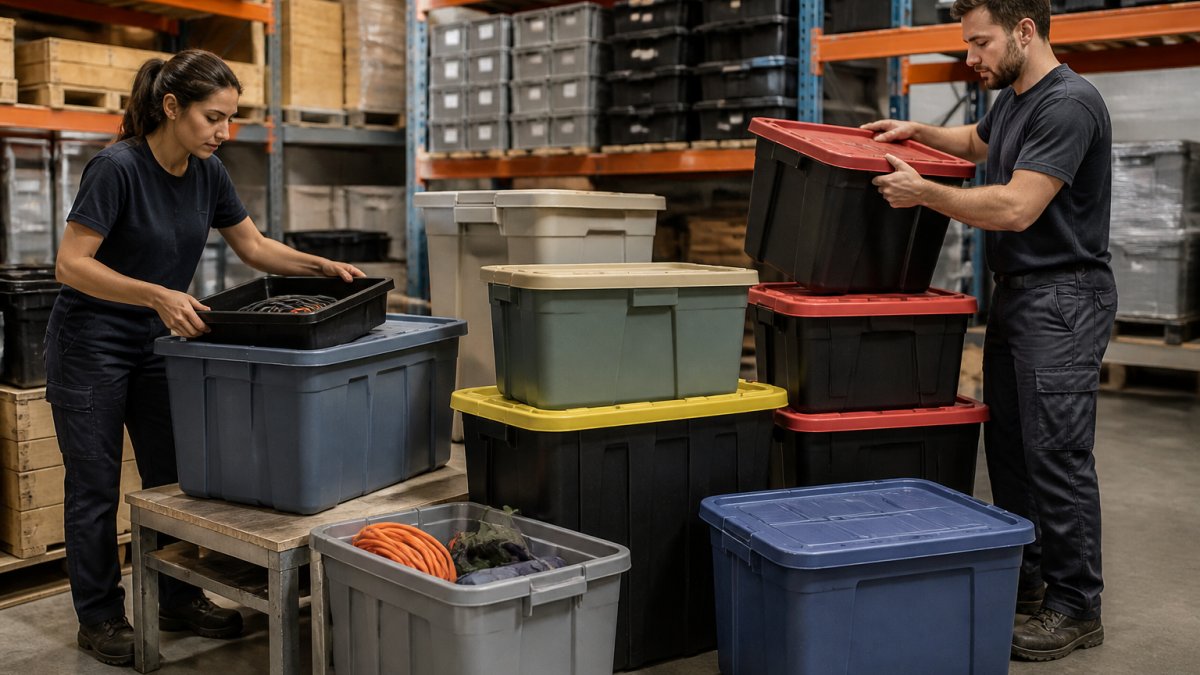
Sterilite Industrial Totes: Capacity Range and Bulk Options
Sterilite's strength is flexibility: if your operation uses multiple tote sizes, its range lets you standardize on one brand across all sizes, simplifying replacement and inventory management.
Rubbermaid Commercial-Grade Bins: Heavy-Item Storage
These bins cost more than basic containers, but for genuinely heavy items the durability difference shows within the first month: standard bins bow under heavy loads, while commercial-grade bins remain rigid.
Nesting Polyethylene Totes: Space-Saving Design
Nesting totes collapse inside one another when empty, cutting storage footprint dramatically, solving a real problem for operations with fluctuating inventory or limited warehouse space.
Polyethylene nesting totes are lighter than HDPE alternatives, easier to handle when stacking or moving, and chemical-resistant enough for most industrial applications, parts storage, food-grade use, or general inventory management.
The tradeoff is stackability: nested totes can't be stacked on top of one another. They're used stacked when full or nested when empty, not both. For operations needing maximum flexibility this matters; for predictable inventory cycles, nesting totes are space-efficient.
The cost per unit is competitive, and the space savings often justify the investment. If empty tote storage consumes significant warehouse space, nesting polyethylene totes reduce that overhead substantially.
How to Choose the Right Commercial Grade Durable Storage Tote
Assess Your Load and Usage
Start by identifying what you're storing. Weight, chemical compatibility, and handling frequency determine the material and design you need.
For heavy tools, metal parts, or dense items, prioritize load capacity. For oils, solvents, or other chemicals, verify chemical resistance, where HDPE outperforms polypropylene.
Handling frequency matters too: if totes move daily, molded handles and reinforced corners prevent wear; if they sit stationary in a climate-controlled warehouse, those features matter less. Match durability features to actual usage, not worst-case scenarios.
Consider Environmental Factors
Temperature extremes, moisture, UV exposure, and chemical contact all degrade plastic. Identify which apply to your storage location.
Cold storage demands cold-resistant plastic. Outdoor storage requires UV resistance and moisture protection, since standard plastic degrades quickly in sunlight. Indoor climate-controlled warehouses allow you to prioritize capacity and cost.
Moisture is often underestimated; even indoor spaces accumulate humidity. Attached-lid totes prevent moisture from entering, protecting contents better than open-top bins. For moisture-sensitive items like electronics, wood products, or food, lids provide insurance against damage.
Evaluate Lid and Closure Options
Open-top bins offer maximum accessibility but no protection. Detachable lids offer flexibility but can be lost or mismatched. Attached lids provide security and prevent loss.
For frequent shipping or inventory moves, attached lids prevent contents from shifting. For stationary warehouse storage, open-top bins reduce handling time and cost.
Latch quality matters when stacking lidded totes: a weak latch fails under pressure, while a strong multi-point latch keeps contents secure even stacked five high or moved by forklift.
| Feature | Best For | Tradeoff |
|---|---|---|
| Open-top bins | Frequent access, stationary storage | No protection from dust or moisture |
| Detachable lids | Flexibility, variety of uses | Lids can be lost or mismatched |
| Attached-lid totes | Shipping, stacking, protection | Higher cost, less accessibility |
| Molded handles | Hand-carrying, frequent movement | Slightly higher cost |
| Nesting design | Space-constrained warehouses | Can't stack when nested |
Durability Testing: What Separates Premium Totes from Standard Bins
Real durability reveals itself under stress. The difference between a tote lasting two years and one lasting ten comes down to repeated use, not initial appearance.
Premium commercial-grade totes undergo impact testing, dropping loaded containers from height to verify they don't crack or leak. Chemical resistance is tested by immersing samples in solvents and oils, and load capacity is verified by stacking weights until failure, establishing a safety margin above rated capacity.
Standard bins rarely undergo this testing; they're designed to meet minimum performance standards at the lowest cost, so they may pass a light-duty test but fail under actual commercial conditions.
Temperature cycling is another revealing test: a tote is frozen, heated, and cycled repeatedly to identify brittleness or warping. Cheap plastic becomes brittle in cold; premium material stays flexible.
Stackability testing loads a tote to rated capacity, stacks five units high, and measures deformation. Premium totes maintain shape; standard bins bow and compress. That compression adds up, and a tote deforming slightly with each stack eventually fails.
The practical reality: a commercial-grade durable storage tote costs 30-50% more upfront than a standard bin, but survives 3-5 times longer, handles heavier loads, and resists chemicals and temperature extremes that destroy standard plastic. For daily storage operations, the cost per year of use heavily favors premium totes.
When evaluating durability, look for totes specifying material type (HDPE vs. polypropylene), wall thickness, and load capacity. Brands that publish test results stand behind their products. Viva homeStore curates storage solutions delivering both functionality and longevity, helping you invest in containers that actually last.
Choosing durable storage totes is an investment in operational efficiency. Commercial-grade totes reduce replacements, minimize product damage, and simplify inventory management. The right tote depends on what you're storing, where, and how often you handle it. At Viva homeStore, we help you find practical storage solutions that maximize space and save time on daily household and workshop tasks. Explore our curated selection of durable containers and organization essentials to create a more functional, organized environment. Shop now and discover how the right storage solution transforms your space.
Frequently Asked Questions
What features make a storage tote commercial grade?
Commercial grade durable storage totes are built with impact-resistant plastics (polyethylene or polypropylene), reinforced handles, stackable or nestable designs, and load capacities exceeding 50 pounds. They resist moisture, grease, and chemicals, feature secure latching lids, and maintain structural integrity through repeated use in warehouses, workshops, and manufacturing environments. Thickness of plastic walls and corner reinforcement distinguish them from standard household bins.
Are attached-lid totes more durable than removable-lid totes?
Attached-lid heavy-duty plastic attached-lid totes offer better security and reduce lid loss, but durability depends on material quality, not lid design alone. Removable-lid industrial storage totes allow easier access and stacking flexibility. For frequent opening and closing, attached lids reduce wear on latching mechanisms. For bulk storage with infrequent access, either design works; choose based on your workflow and whether you need secure closure during transport.
What size storage tote is best for heavy or bulky items?
27-gallon storage totes balance capacity with manageability for heavy loads, offering roughly 100 pounds of load capacity depending on material. Larger totes (40+ gallons) hold more but become difficult to move when full. For bulky items, prioritize load capacity rating and reinforced handles over volume. Measure your items first, then select a tote with 20% extra capacity to avoid overfilling, which reduces stackability and stresses plastic.
How can you tell whether a plastic storage tote will hold up to frequent use?
Check the plastic material (high-density polyethylene or polypropylene resists impact better), wall thickness (thicker plastic indicates durability), load capacity rating in pounds, and handle design (molded or reinforced handles outlast thin ones). Look for UV resistance if storing outdoors, and chemical resistance if storing automotive fluids or solvents. Read reviews mentioning long-term use in warehouses or commercial kitchens, not just household storage.