

Best Drawer Dividers for Kitchen Utensil Organization
Table of Contents
- Quick Comparison: Best Drawer Dividers for Kitchen Utensil Organization
- How We Tested Drawer Organizers
- Best Overall Drawer Dividers
- Best Expandable and Adjustable Options
- Best for Deep Drawers and Large Utensils
- Customizable Kitchen Drawer Dividers for Odd Sizes
- How to Organize Kitchen Drawers Without Dividers
- Kitchen Drawer Divider Installation Tips
- Frequently Asked Questions
Last Updated: September 19, 2026
Quick Comparison: Best Drawer Dividers for Kitchen Utensil Organization
The best drawer dividers for kitchen utensil organization balance three things: a fit that matches your drawer's internal dimensions, compartments sized for the utensils you actually own, and a material that survives daily use. This guide breaks down the top options by price, material, and use case.
A messy utensil drawer slows down every meal you cook. When spatulas, whisks, and flatware tumble together, you waste time hunting for the right tool and risk scratching non-stick cookware with exposed blades. A well-chosen organizing system fixes that in an afternoon.
Below, we explain how to measure your drawer before you buy. The table below summarizes the field at a glance.
| Divider | Starting Price | Material | Best For |
|---|---|---|---|
| Viva homeStore curated organizers | Varies by set | Bamboo, plastic, metal | Complete, coordinated drawer systems |
| Pipishell Bamboo Expandable | $20 | Bamboo | Aesthetic, durable expandable tray |
| OXO Good Grips Expandable | $25 | Plastic | Long tools and spatulas |
| Lifewit Expandable Silverware | $18 | Plastic | Large flatware collections |
| SpaceAid Bamboo Adjustable | $22 | Bamboo | Custom, built-in look |
| Vtopmart 8 Pack Adjustable | $15 | Clear plastic | Minimalist, modular layouts |
How We Tested Drawer Organizers
A common mistake is buying for the drawer's outer size instead of its internal dimensions. Most drawers lose 1-2 cm to wall thickness and hardware, which is enough to make an expandable tray wobble or a rigid insert refuse to sit flat.
We also weighed cleaning. Utensil drawers collect crumbs and grease splatter, so removable, wipe-clean designs earned higher marks than fixed units with deep crevices.
Best Overall Drawer Dividers
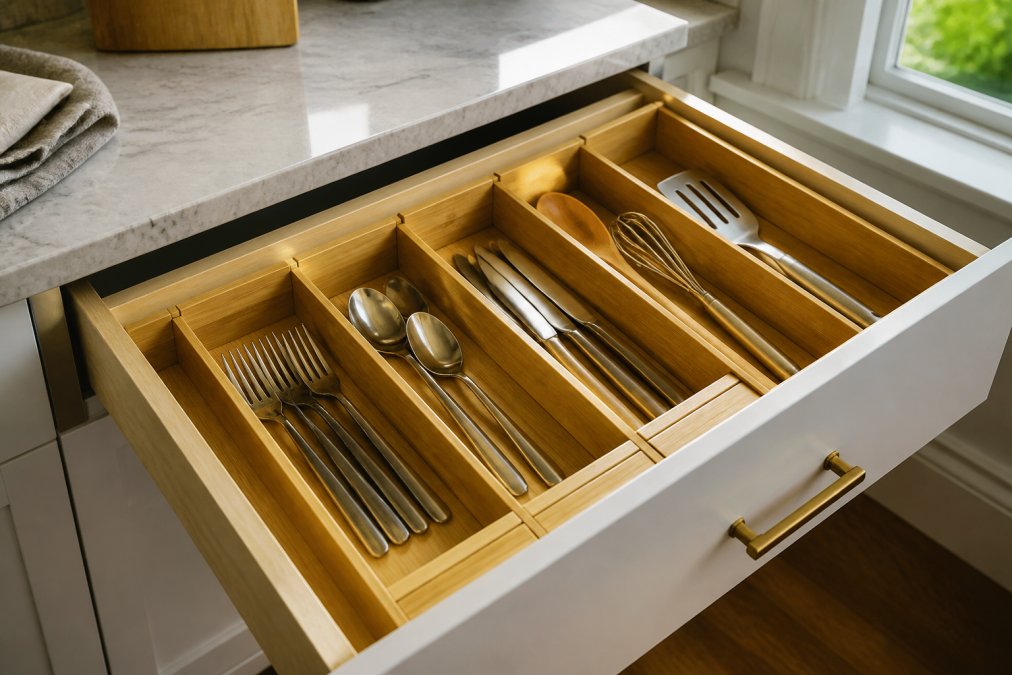
The Viva homeStore curated selection of drawer organizers lets you build a coordinated system around your exact drawer rather than forcing one tray to do everything. The range covers bamboo, plastic, and modular bins, so you can match compartments to your actual utensil mix.
For a single-tray solution, the Pipishell Bamboo Expandable Drawer Organizer expands to fit different drawer widths, uses durable bamboo, and offers multiple compartments for sorting flatware and gadgets. The natural wood finish looks good enough to leave visible in an open drawer.
The one drawback: it needs specific drawer dimensions to expand correctly. If your drawer is unusually shallow or deep, check the fit before ordering.
Best Expandable and Adjustable Options
Expandable dividers win when your drawer size is fixed but your utensil collection keeps growing. The OXO Good Grips Expandable Kitchen Tool Drawer Organizer targets long tools: its expandable sides create a custom fit, removable dividers let you reconfigure the layout, and non-slip feet stop the whole tray from sliding when you pull the drawer open.
The trade-off is footprint.
Best for Deep Drawers and Large Utensils
If your drawer is truly deep:
A note on weight: stacking doubles the load on the drawer's bottom panel and slides. Keep cast-iron or heavy wooden tools in the bottom layer, and reserve the upper bins for lightweight items like measuring cups and silicone spatulas. If the drawer begins to sag or the slides feel stiff, redistribute the weight rather than adding another tier.
Customizable Kitchen Drawer Dividers for Odd Sizes
Customizable kitchen drawer dividers solve the problem standard trays cannot: drawers that are too narrow, too wide, or oddly shaped. The SpaceAid Bamboo Adjustable Drawer Dividers use a spring-loaded mechanism to wedge into place, with adjustable length and protective foam pads that prevent drawer damage. They install and remove in seconds.
How to Organize Kitchen Drawers Without Dividers
You can organize kitchen drawers without dividers using inexpensive bins, tension rods, and a simple zone system. The goal is compartmentalization without a permanent installation, and, just as important, a layout you can actually keep clean.
Try this approach:
- Empty the drawer completely and wipe it clean.
- Group utensils by task: cooking tools, baking tools, serving pieces, flatware.
- Add small open bins to separate each group. Even mismatched containers work.
- Use a tension rod across the drawer to create a vertical divider for cutting boards or trays.
- Place most-used tools at the front to reduce reaching.
- Line the base with non-slip matting so bins stay put when the drawer opens.
Cleaning and Sanitation for Food-Contact Drawers
This is the part most guides skip. Utensil drawers are food-contact storage, and they collect crumbs, flour dust, and grease splatter from cooking. Over time, that residue feeds mold and bacteria, especially in humid climates or in homes where the drawer sits near a dishwasher vent.
Ergonomic Layouts for Limited Mobility
If reaching into the back of a drawer is painful, whether from arthritis, a shoulder injury, or general stiffness, the no-divider approach can actually work better than a fitted tray, because you control the bin placement.
- Keep the heaviest and most-used tools in a shallow bin at the front edge, so you never have to reach past anything.
- Use open, rimless bins rather than deep trays with tall walls; you can grab a utensil without lifting it over an edge.
- Choose high-contrast colors, dark bins in a light drawer or vice versa, so tools are visible at a glance instead of requiring a search by touch.
- Avoid spring-loaded dividers entirely if grip strength is limited; they require a firm squeeze to install and can pop loose.
End-of-Life and Disposal
When a plastic bin cracks or a bamboo tray finally gives out, disposal matters. Bamboo and other natural-wood organizers are biodegradable and can often go into municipal yard-waste or compost programs, though laminated or heavily finished pieces may not qualify. Clear plastic trays are recyclable only if your local program accepts that resin type, check the number stamped on the bottom, since many curbside programs take only #1 and #2 containers and reject the #5 and #6 plastics common in budget organizers.
Kitchen Drawer Divider Installation Tips
- Measure internal width, depth, and height before buying
- Check that the divider clears the drawer's closing mechanism
- Clean and dry the drawer base so non-slip feet grip properly
- Apply foam pads on spring-loaded dividers to protect the drawer walls
- Load heaviest utensils toward the back for stability
- Test the drawer's full travel to confirm nothing catches
A note on sustainability: bamboo dividers come from a fast-renewing resource and typically outlast plastic alternatives, which matters if you want to avoid replacing organizers every couple of years. Check whether your local recycling program accepts the plastic types used in clear trays before disposal.
Frequently Asked Questions
What drawer dividers are best for utensils?
Expandable and adjustable options work best for most kitchens because they fit different drawer widths and let you create compartments for flatware, spatulas, and gadgets. Bamboo dividers like the Pipishell model offer durability and a warm look, while plastic versions such as the Lifewit tray provide deeper compartments. For long tools, the OXO Good Grips organizer has removable dividers that accommodate oversized utensils. Measure your drawer's internal dimensions first so the divider fits without sliding.
Are bamboo or plastic drawer dividers better for kitchens?
Bamboo dividers resist moisture, look premium, and hold up well over time, but they usually cost more and may need occasional oiling. Plastic dividers are lighter, easier to clean, and budget-friendly, though some can feel flimsy or crack if dropped. If you want a natural aesthetic and long-term durability, bamboo is a solid choice. For high-capacity storage on a tight budget, plastic trays like the Lifewit expandable organizer deliver more compartments. Both materials are food-safe when labeled BPA-free.
How do I organize kitchen drawers without dividers?
You can organize without dividers by using small bins, mason jars, or cutlery trays as makeshift compartments. Group similar utensils together, place frequently used items near the front, and use vertical space with stackable containers. A non-slip liner underneath bins prevents sliding. Another trick is to store utensils upright in a deep drawer using a crock or a repurposed container. These methods work well for renters or anyone testing a layout before buying permanent dividers.
What is the best drawer organizer for large utensils?
The OXO Good Grips Expandable Kitchen Tool Drawer Organizer is designed specifically for long tools like spatulas, ladles, and tongs. Its expandable sides and removable dividers let you create wide compartments that fit oversized utensils. For deep drawers, stackable bamboo bins from Kyoto or similar brands let you use vertical space so large tools don't overlap. Measure the depth of your drawer and the height of your tallest utensil before choosing, since some organizers are too shallow for bulky items.
Your utensil drawer does not have to be a daily frustration. Viva homeStore offers a curated range of practical, space-saving organizers designed to fit real kitchens, from expandable bamboo trays to modular bins that adapt as your collection grows. Every pick here helps you save time on daily tasks, use your drawer space fully, and keep the whole family's cooking routine running smoothly. Shop now at Viva homeStore and build a drawer system that finally stays organized.