

Best Pull Out Spice Rack for Narrow Cabinets: 2026 Guide
Table of Contents
- Quick Comparison: Top Picks for Narrow Cabinets
- How to Measure Cabinets for Spice Rack Inserts
- Best Pull Out Spice Rack for Narrow Cabinets: 5 Options That Fit
- DIY Pull-Out Spice Rack for Narrow Cabinets
- Best Spice Storage Solutions for Small Kitchens
- Installation Tips and Troubleshooting for Tight Spaces
- Frequently Asked Questions
Last Updated: September 13, 2026
Quick Comparison: Top Picks for Narrow Cabinets
The best pull out spice rack for narrow cabinets solves a problem most kitchens create by accident: a 3- to 6-inch gap that holds nothing useful. This guide from Viva homeStore compares five racks that fit those gaps, plus a DIY route for non-standard sizes.
Narrow cabinets punish guesswork: a rack 1/4 inch too wide won't slide, and one too shallow wastes depth. We scored every option on width, glide capacity, install difficulty, and removability.
| Rack | Width Range | Mechanism | Install | Best For |
|---|---|---|---|---|
| Viva homeStore | Slim modular options | Pull-out tiers | No-drill options | Most narrow cabinets |
| Lynk Professional | Expandable | Drawer insert | Hardware included | Existing drawers |
| DABIGE | 4.4 in fixed | Slide-out | DIY-friendly | Tight gaps, low budget |
| Vertical Spice | Custom | Angled pull-out | Screw-in | Deep, high-capacity |
| Wayfair 3-Tier | Filler spaces | Pull-out | Basic tools | Awkward filler gaps |
| YouCopia SpiceStack | Compact | Stackable | None | Renters |
How We Evaluated These Racks
We weighted fit first, because it's the only spec that can't be worked around. We also checked load capacity, glide quality, and hardware: screw-in mounting outlasts adhesive under heavy jars, and tiers must keep labels visible from a standing position.
How to Measure Cabinets for Spice Rack Inserts
Measuring for spice rack inserts takes five minutes and three numbers. Measure the opening, not the door:
- Clear the cabinet. Remove shelves and anything loose so you're measuring bare interior surfaces.
- Measure the interior width at the front, middle, and back of the opening. Use the smallest number.
- Measure the interior depth from the back wall to the inside edge of the face frame.
- Measure the interior height from the cabinet floor to the underside of the top.
- Check the door swing. A pull-out needs the door open past 90 degrees to extend fully.
Write the smallest width down. Cabinet boxes are rarely perfectly square, and a rack sized to your widest measurement will jam.
Width, Depth, and Clearance Requirements
Clearance is the number people skip, and it causes most returns. A pull-out rack needs its full depth plus roughly an inch of travel room in front of the cabinet face, or the door won't close over the extended tiers (woodworkingnetwork.com).
| Measurement | What to Record | Why It Matters |
|---|---|---|
| Interior width | Smallest of 3 points | Determines rack width |
| Interior depth | Back wall to face frame | Determines tier depth |
| Interior height | Floor to top | Caps tier count |
| Door clearance | Swing past 90 degrees | Full extension access |
| Face frame lip | Overhang width | Blocks oversized racks |
For a narrow cabinet, the face frame is your enemy. Many cabinets have a 1- to 2-inch lip that narrows the usable opening well below the interior width. Measure between the frame edges, not the box behind it.
Best Pull Out Spice Rack for Narrow Cabinets: 5 Options That Fit
The best pull out spice rack for narrow cabinets depends on whether you have a drawer, a filler gap, or a full-height cabinet door. Here are five that cover those cases.
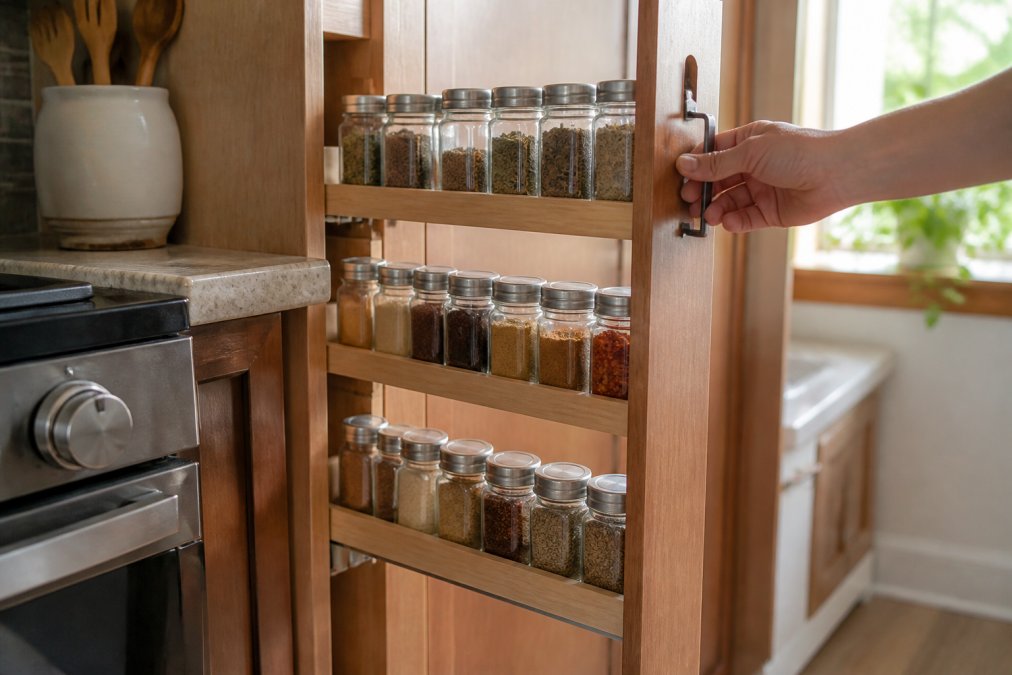
1. Viva homeStore Pull-Out Spice Organizers
Our top pick for most narrow cabinets. Viva homeStore curates practical, space-efficient home essentials, and the spice organizer range is built around exactly the problem this guide addresses: maximizing a cabinet you'd otherwise waste.
What sets the range apart is the fit philosophy: narrow cabinets vary more than standard ones, so a system that adapts beats a rigid rack that only works in one opening. The limitation: Viva homeStore carries a curated selection rather than every possible size, so measure carefully before ordering.
2. Lynk Professional Expandable Spice Rack
Lynk's expandable design is the smartest option if you already have a shallow drawer you're not using well. The rack widens to match your drawer width, so one unit covers a range of sizes. Heavy-gauge steel holds up to daily sliding without flexing, and it starts around $40. The catch: it needs an existing drawer, so it won't help a cabinet with fixed shelves.
3. DABIGE Slide Out Spice Rack Organizer
At 4.4 inches wide and 10.5 inches deep, the DABIGE is built for the gaps other racks can't touch. Three tiers, a smooth sliding mechanism, and a footprint that fits genuinely narrow openings. Around $35, it's the budget pick. The limitation: it's fixed at those dimensions, so if your cabinet is 5 inches wide, this isn't your rack.
4. Vertical Spice Pull-Out Drawers
Vertical Spice's patented angled drawers tilt downward as they extend, keeping labels readable without crouching. Units hold up to 30 spices, and the company offers custom sizing for non-standard cabinet depths. It's the strongest choice for deep, narrow cabinets where capacity matters more than price. You'll need accurate measurements, and pricing is quote-based.
5. Wayfair 3-Tier Pull-Out Spice Rack
Wayfair's three-tier unit targets the filler space beside your range, the 3- to 6-inch strip most kitchens ignore. Easy-glide mounting hardware and a durable metal finish, around $65. Installation needs basic tools, and it works best as a permanent addition rather than something you'll relocate.
DIY Pull-Out Spice Rack for Narrow Cabinets
Building a DIY pull-out spice rack for narrow cabinets costs less than a pre-built unit and fits openings no manufacturer covers. The trade-off is time, a few tools, and getting the slide choice right the first time.
What You Actually Need
- Two side-mount drawer slides. Use 3/4-extension or full-extension ball-bearing slides rated for at least 50 lb per pair (rockler.com). Cheap roller slides are the biggest cause of sagging DIY racks.
- One piece of 1x3 or 1x4 lumber cut to your interior depth minus 1 inch. A 1x3 gives roughly 2.5 inches of usable shelf width; a 1x4 gives about 3.5 inches. That difference decides whether your jars fit upright.
- A mounting cleat or bracket to attach the slides to the cabinet sides or back.
- Tiered shelving material, thin wood strips, vinyl-coated steel, or a second 1x3 cut into risers.
- A small level and a pencil. A stud finder is not needed for cabinet interiors.
Step-by-Step Build
- Cut the base to your interior depth minus 1 inch. The gap lets the rack clear the face frame when it slides.
- Mark slide height. Set the slides so the rack base sits about 1/8 inch above the cabinet floor, so it doesn't drag when the box flexes under load.
- Attach the cabinet-side slides first. Mount them level to each other, a 1/16-inch mismatch will bind the rack within a week.
- Attach the rack-side slides to the base, then test the slide action before adding tiers.
- Add tiers. Space them to your tallest jar plus 1/2 inch. A 1x3 base typically holds two rows of standard 1.5- to 2-inch spice jars.
- Load heavy jars at the back and bottom. Keep the front light so the slides don't fight the weight.
Slide Types and What They Cost You
| Slide Type | Extension | Typical Load Rating | Best For |
|---|---|---|---|
| Roller | 3/4 | 35-50 lb | Light, budget builds |
| Ball-bearing | Full | 50-100 lb | Daily-use spice racks |
| Undermount | Full | 75-100 lb | Clean look, harder install |
| Soft-close | Full | 75-100 lb | Heavy jars, no slam |
For a spice rack, ball-bearing full-extension slides are the practical default. They let the back row clear the face frame, which is the whole point of a pull-out in a narrow cabinet.
Fitting Non-Standard Openings
This is where DIY beats off-the-shelf. If your cabinet is deeper than the slide length, add a spacer block behind the rear mounting bracket to bring the slides forward. If it's shallower, mount the slides to the cabinet sides rather than the back, side-mounting also handles cabinets with no usable back panel. For a cabinet narrower than 4 inches, skip the side-mount slides and use a single bottom-mount slide with a top guide, the only mechanism that fits a true 3-inch gap.
When DIY Is the Wrong Call
If your cabinet has a fixed center shelf, a glass front, or a face frame narrower than 3 inches, a pre-built rack or freestanding organizer is the better route. DIY wins on fit, not finish, a homemade rack rarely matches the powder-coated look of a manufactured unit.
Best Spice Storage Solutions for Small Kitchens
The best spice storage solutions for small kitchens share one trait: they use vertical space instead of horizontal. Countertop racks and magnetic strips free up cabinet interiors, while tiered shelving multiplies usable depth. But the right pick depends on who is reaching for the jars and how often.
Match the Solution to the Constraint
| Constraint | Best Solution | Why |
|---|---|---|
| Renting, no drilling | Freestanding stackable organizer | No installation, no landlord conversation |
| 3- to 6-inch filler gap | Pull-out filler rack | Uses space nothing else reaches |
| Deep narrow cabinet | Angled pull-out drawers | Labels readable without crouching |
| Limited counter space | Wall-mounted magnetic strip | Frees the counter entirely |
| Limited mobility | Angled or downward-tilting pull-out | Reduces reach and bend |
| Glass-front cabinet | Neutral powder-coated finish | Disappears behind the door |
Accessibility Is the Overlooked Constraint
Most guides treat spice storage as a space problem. For anyone with limited mobility, arthritis, or a reach limitation, it's an ergonomics problem first. The features that matter are different:
- Angled or downward-tilting tiers keep labels visible from a standing position, so you don't bend or crouch to identify a jar.
- Full-extension slides bring the back row to the front, cutting how far you reach into the box.
- Smooth-glide ball-bearing slides need less force to start moving than roller slides, which matters for weaker grip strength.
- Single-tier or two-tier units reduce the height you reach over compared to a tall stacked rack.
A deep, straight pull-out with a high top tier is the worst choice for this user; an angled two-tier pull-out with full-extension slides is the best.
Renters Versus Owners
For renters, the YouCopia SpiceStack is the practical answer. Adjustable dividers handle different bottle sizes, pull-out drawers keep everything reachable, and non-slip feet hold it steady. No installation, no drilling, no landlord conversation. Around $30. The trade-off: it's not a permanent cabinet mount, so it lives on a shelf or counter rather than sliding out of a dedicated opening. For owners, a permanent pull-out uses space a stackable organizer can't reach and keeps your counter clear.
Vertical Space Without a Cabinet
If your kitchen has no usable narrow cabinet, the vertical-space principle still applies:
- Magnetic strips on the side of the refrigerator or a range hood hold 8-12 jars and free the counter completely.
- Over-the-door racks use the inside of a pantry door, often wasted depth.
- Stackable risers inside an existing cabinet double the usable shelf count without hardware.
The common mistake is buying a countertop carousel for a kitchen that already has a narrow cabinet going unused. Fix the wasted cabinet first, then add countertop storage only if you still need it.
Installation Tips and Troubleshooting for Tight Spaces
Most installation problems in tight spaces trace back to three causes: the face frame, the door swing, and weight distribution.
Screw-in versus adhesive. Screw-in mounting is the durable default for any rack holding glass jars. Adhesive strips work for lightweight, renter-friendly setups but fail over time under load. If you rent and can't drill, use a freestanding organizer instead of adhesive hardware on a pull-out.
Non-standard cabinet depths. When your cabinet is deeper or shallower than the rack, add a spacer block behind the mounting bracket to bring the slides forward, or mount the slides to the cabinet sides rather than the back.
Preventing shelf bowing. Load heavy jars at the back and bottom tiers, keep the front light, and avoid stacking two heavy jars on one shelf section. If a tier starts bowing, add a center support rather than removing jars, because a bowed shelf will bind the slides.
Accessibility for limited mobility. Prioritize a rack with angled tiers and smooth full-extension slides over a deep, straight pull-out.
Aesthetic integration. Match the rack's finish to your cabinet interior or drawer pulls. Vinyl-coated steel and powder-coated finishes come in neutral tones that disappear behind a closed door, while bright chrome reads as an appliance.
U.S. Consumer Product Safety Commission guidance on household product safety
Frequently Asked Questions
How do I organize spices in a very narrow cabinet?
For cabinets narrower than 6 inches, look for slim pull-out racks like the DABIGE Slide Out Organizer (4.4-inch width). Measure your interior width first, then choose a rack that leaves at least 0.25 inches of clearance on each side. Tiered shelving and vertical storage help you see labels without pulling everything out. If your cabinet is too narrow for a pull-out, stackable organizers like the YouCopia SpiceStack work on existing shelves.
What is the minimum width needed for a pull-out spice rack?
Most pull-out spice racks need at least 3 inches of interior cabinet width. Slim models can fit 3-inch gaps, while the DABIGE organizer requires 4.4 inches. Standard pull-outs typically need 5 to 6 inches. Always measure the inside of your cabinet frame, not the door opening, because the frame adds thickness. Add 0.25 inches on each side for the mounting bracket and smooth sliding.
Are pull-out spice racks worth it for small kitchens?
Yes, if you cook often and struggle to reach spices in deep cabinets. Pull-out racks use vertical storage and tiered shelving to make every jar visible and accessible. They reduce clutter and save time during meal prep. For very tight budgets, a non-permanent option like the YouCopia SpiceStack costs around $30 and requires no installation. Permanent pull-outs cost more but add lasting convenience and can increase usable cabinet space by 30 to 40 percent.
What are the best materials for a durable pull-out spice rack?
Vinyl-coated steel and heavy-gauge steel are the most durable options for daily use. Steel resists rust and holds up to repeated sliding without bending. Ball-bearing glides provide smooth operation and support heavier loads. Plastic racks are lighter and cheaper but can crack over time. Wood looks warm but may warp in humid kitchens. For narrow cabinets, steel racks with a rust-resistant finish offer the best balance of strength and slim profile.
Narrow cabinets are the hardest storage problem in a kitchen, and most racks are designed for standard 12-inch openings that leave you guessing. Viva homeStore carries a curated range of modular, space-efficient organizers built around exactly this constraint, with practical accessories, lighting, and furniture for the rest of the room. Start by measuring your face-frame opening, then shop the Viva homeStore collection and turn that wasted gap into usable storage.