

Corner Cabinet Storage Solutions for Kitchens: 2026 Guide
Table of Contents
- Why Corner Cabinets Waste Space (And What It Costs You)
- Lazy Susan Cabinet Inserts: Still the Go-To Option?
- Blind Corner Cabinet Organizers: Pull-Out and Swing-Out Systems
- Corner Drawers and Angled-Front Cabinet Designs
- Corner Cabinet Storage Ideas for Small Kitchens
- DIY vs. Professional Installation: What to Expect
- Maintenance and Cleaning: Keeping Corner Storage Functional
- Frequently Asked Questions
Last Updated: September 27, 2026
Why Corner Cabinets Waste Space (And What It Costs You)
The average kitchen loses usable storage in the corner, the dead zone where the blender and the one-recipe pan go to retire. If you're searching for corner cabinet storage solutions for kitchens, the real problem isn't space. It's access.
Lazy Susan Cabinet Inserts: Still the Go-To Option?
Yes, and for good reason. Lazy Susan cabinet inserts remain the most popular corner solution because they're affordable, widely available, and simple to install. A lazy susan is a rotating tray that spins inside the corner so you can reach items at the back without crawling in.
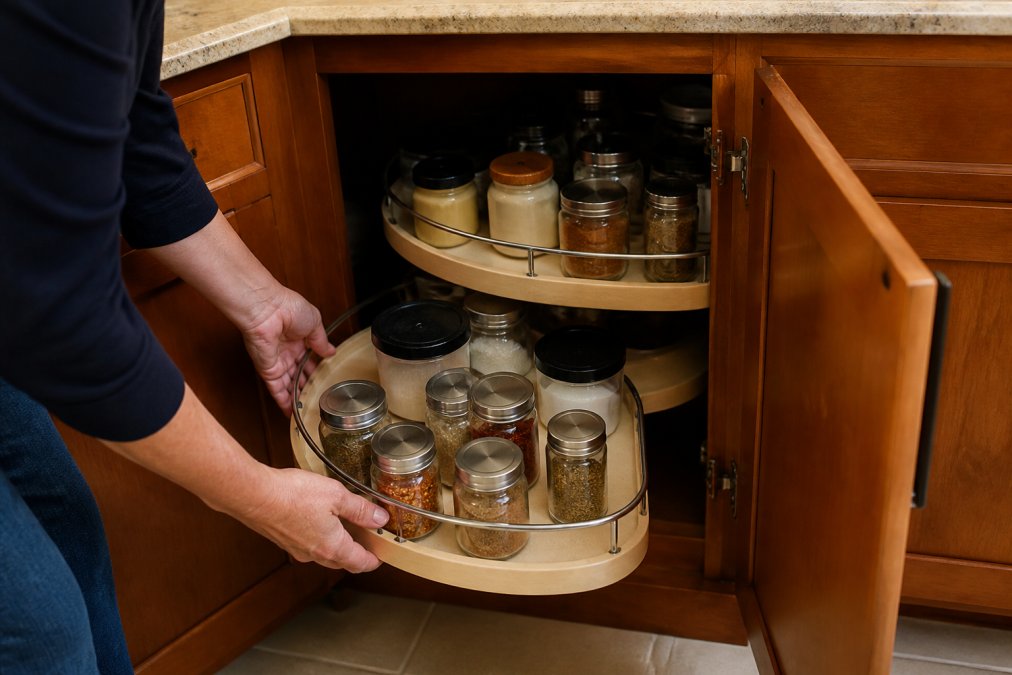
Full-Circle vs. Kidney-Shaped Trays
The shape matters more than most buyers realize.
- Full-circle trays maximize surface area but can block the door from closing. Best for cabinets with a wide opening.
- Kidney-shaped trays leave a cutout so the door swings shut cleanly. They fit standard corner base cabinets with a single door.
- Two-tier and three-tier versions multiply vertical storage without eating floor space.
One door: choose kidney-shaped. Wide diagonal opening: a full circle gives you more room.
Anti-Slip Surfaces and Soft-Close Hardware
Two upgrades separate a frustrating lazy Susan from a great one.
Blind Corner Cabinet Organizers: Pull-Out and Swing-Out Systems
Blind corner cabinet organizers solve the hardest corner type: the one where a wall or appliance blocks half the opening. A lazy Susan won't work here because you can't reach the back. These systems pull the entire shelf out into the room instead.
Two designs dominate: LeMans-style pull-outs and Magic Corner units.
| System | How It Moves | Best For | Main Drawback |
|---|---|---|---|
| LeMans pull-out | Trays swing out and glide forward | Blind corners, everyday access | Costs more than basic trays |
| Magic Corner unit | Shelves pull out as the door opens | Deep pantry-style corners | Complex installation |
| Sliding drawers | Drawers slide straight out | Narrow blind corners | Needs precise measuring |
LeMans-Style Pull-Outs vs. Magic Corner Units
A LeMans corner pull-out uses kidney-shaped trays that swing completely out of the cabinet on a pivoting arm, with full visibility and independent gliding. Most models offer a soft-close mechanism, making it the better pick for smooth, ergonomic access to a blind corner.
Weight Capacity: What Heavy-Duty Really Means
Weight capacity is where cheap organizers fail. A shelf rated for light items will sag under a cast-iron skillet or a stand mixer, so look for heavy-duty ratings and steel construction when storing appliances. Fixed shelf mounting is more stable than pole-mounted designs, which can wobble under load.
Corner Drawers and Angled-Front Cabinet Designs
Corner drawers and angled-front designs trade the rotating tray for drawers that wrap around the corner. The drawer front sits at an angle, so it opens into the room instead of into a dead zone, the cleanest look for a modern kitchen, and the only corner solution that gives you full-extension access without a spinning or swinging mechanism.
How Corner Drawers Actually Work
A corner drawer uses a pie-cut or L-shaped drawer box that rides on two sets of full-extension glides mounted at 90 degrees to each other, traveling diagonally out of the corner. The drawer front is typically a 45-degree angled panel facing the room. Three configurations dominate:
- Single angled drawer, one deep drawer with a diagonal front. Best for pots and small appliances.
- Two-drawer stack, a shallow top drawer for utensils and a deep bottom drawer for cookware. The most useful layout for daily cooking.
- Corner drawer plus door combo, a drawer on top, a swing-out door below for tall items like stockpots or a stand mixer.
Weight Capacity: What the Spec Sheet Won't Tell You
This is the gap almost every ranking article misses. A corner drawer's real limit isn't the drawer box, it's the glide pair. Two 90-degree glides share the load unevenly, so the effective capacity is usually lower than the same glide rated in a straight cabinet.
- A drawer rated for 75 lbs in a straight run may only handle 50-60 lbs in a corner because the load sits off-axis.
- Cast iron, stoneware, and stand mixers most often exceed a corner drawer's real limit.
- Look for undermount glides with a 100-lb class rating for cookware. Side-mount epoxy glides sag first.
Angled-Front Cabinets: The Remodel-Only Option
An angled-front cabinet replaces the blind corner with a diagonal face, usually 24 to 36 inches wide, that gives you a normal door and normal access, with a full-depth cabinet and no dead zone.
Which One Should You Pick?
| Situation | Best Pick | Why |
|---|---|---|
| Existing cabinet, want drawers | Skip it, go pull-out | Corner drawers need a new box |
| Remodel, want clean lines | Angled-front cabinet | No mechanism to maintain |
| Remodel, want max storage | Two-drawer corner stack | Uses full corner depth |
| Heavy cookware storage | Pull-out with fixed shelves | Better weight distribution |
DIY vs. Professional: The Honest Answer
Corner drawers and angled-front cabinets are not DIY projects. Both require cutting the cabinet frame, and a mistake means replacing the box. Homeowners often order a corner drawer kit, discover their cabinet opening is off by a quarter inch, and pay a carpenter more to fix it than the kit cost.
Corner Cabinet Storage Ideas for Small Kitchens
Small kitchens need corner storage ideas that squeeze every inch out of limited space. The goal is storage optimization, not more cabinets, and the biggest opportunity most guides ignore is the under-$50 fix. You don't need a LeMans pull-out to reclaim a dead corner, just the right cheap hardware, installed correctly.
Under $25: The Non-Slip Liner Fix
A rotating tray that slides items around is worse than no tray at all. A roll of non-slip shelf liner, the rubberized grid kind sold at any hardware store, costs a few dollars and stops jars from tipping as the tray spins.
Under $50: The Two-Tier Kidney Tray
A two-tier kidney-shaped lazy Susan is the single best dollar-per-square-foot upgrade for a standard corner base cabinet. It doubles the usable surface without eating floor space, and the kidney cutout lets a single door close cleanly. Look for a steel or heavy-duty polymer center pole (plastic poles wobble within a year), raised rims so items don't slide off during a spin, and adjustable tier height so tall bottles fit on the bottom and short spices on top.
Under $100: The Door-Mounted Susan
A door-mounted lazy Susan attaches the spinning shelves directly to the cabinet door, so the whole tray swings out when you open it. This eliminates the door-swing problem entirely, the smartest pick for tiny kitchens because it uses the door itself as the access mechanism.
The $0 Hack: Re-Zone What You Already Have
Before you buy anything, empty the corner cabinet and re-sort by frequency of use, not by category.
- Daily items go in the front third, where you can reach without kneeling.
- Weekly items go in the middle third.
- Holiday and specialty items go in the back third, or better, out of the kitchen entirely.
The $15 Hack: Clear Stackable Bins
Clear stackable bins turn a deep corner shelf into pull-out drawers without any hardware. You pull the bin, not the item. Label the front edge with a marker so you can see what's inside without lifting the lid.
The $30 Hack: An Under-Shelf Basket
An under-shelf wire basket hangs from the shelf above and creates a second storage layer in the vertical dead zone, the cheapest way to add a tier in a corner cabinet without buying a new tray system.
What to Skip
- Full-circle trays in single-door cabinets, they block the door from closing.
- Three-tier plastic Susans, the pole flexes and the top tier is unreachable.
- Corner carousels with no rim, items slide off the moment you spin.
- Any organizer you haven't measured for, a tray half an inch too wide won't spin, and one too narrow leaves a gap where items fall through.
Measure the interior opening first. Then buy. In that order.
DIY vs. Professional Installation: What to Expect
Some corner solutions install in under an hour. Others need a professional.
Maintenance and Cleaning: Keeping Corner Storage Functional
Corner storage stays functional only if you maintain it. Rotating trays collect crumbs and spills in the gap between the tray and the cabinet floor. Pull-out tracks gather dust and lose their glide over time.
A simple routine keeps everything working:
- Wipe tray surfaces and rims monthly to prevent sticky buildup.
- Vacuum or brush pull-out tracks every few months.
- Check screws and mounting points twice a year, since vibration loosens hardware.
- Reapply lubricant to glides if they start to stick.
Frequently Asked Questions
What is the best storage solution for corner kitchen cabinets?
The best option depends on your cabinet type and budget. For standard corner base cabinets, a lazy Susan cabinet insert is affordable and easy to install yourself. Blind corner cabinets benefit most from pull-out organizers like LeMans-style trays or Magic Corner units that bring items into reach. If you are remodeling, corner drawers with angled fronts offer the cleanest look and easiest access. Match the solution to your cabinet dimensions and how often you use the items stored there.
Are lazy Susans still the best option for corner cabinets?
Lazy Susans remain a solid choice for standard corner base cabinets, especially at budget-friendly price points. They rotate 360 degrees, fit most cabinet sizes, and are simple to install without professional help. However, they have limits: items can slide off the edge, and they do not work well in deep blind corners. For those spaces, pull-out systems or swing-out shelves give better access and use more of the available depth.
How do I maximize storage in a blind corner cabinet?
Blind corner cabinets hide a large section of space behind a wall or adjacent cabinet. The most effective fix is a pull-out organizer with tandem shelves that glide toward you as the door opens. These systems use the full depth of the cabinet and keep items from disappearing into the back. Measure your cabinet opening carefully before buying, since most pull-out units require specific dimensions. Heavy-duty slides rated for at least 50 pounds per shelf handle cast iron and small appliances safely.
Can I install corner cabinet organizers myself or do I need a professional?
Many corner cabinet storage solutions are DIY-friendly. Lazy Susans, drop-in tray systems, and some sliding drawers install with basic tools and a screwdriver. Pull-out systems with complex hardware, corner drawers, and custom-fitted inserts usually require professional installation because they need precise alignment and sometimes cabinet modification. If your cabinet has an odd size or you are unsure about weight limits, hiring an installer saves time and prevents costly mistakes.