

Durable Storage Bins That Actually Last: 2026 Guide
Table of Contents
- What Makes Durable Storage Bins That Actually Last
- Heavy Duty Storage Bins for Demanding Environments
- Waterproof Outdoor Storage Bins for Long-Term Protection
- Plastic Storage Bins for Extreme Temperatures
- Storage Bins With Secure Latches That Hold Over Time
- Long-Term Durability: What Testing Reveals
- How to Choose Durable Storage Bins That Actually Last for Your Needs
- Conclusion
Durable Storage Bins That Actually Last: 2026 Guide
Last Updated: July 25, 2026
When storage fails, it usually fails quietly. A bin cracks in your garage. Moisture seeps into the seal. Handles snap under load. Finding durable storage bins that actually last requires understanding what separates a bin that survives five years from one that fails in five months. At Viva homeStore, we've tracked how different storage solutions perform across temperature swings, stacking stress, and long-term environmental exposure. This guide breaks down the material science, structural engineering, and real-world durability factors that determine whether a storage bin becomes a reliable workhorse or a costly mistake.
The difference between a cheap bin and a durable storage bin comes down to three things: material quality, structural design, and seal integrity.
What Makes Durable Storage Bins That Actually Last
Durability results from deliberate material choices and engineering decisions that compound over years of use. A bin that holds up in a climate-controlled closet will fail in an uninsulated attic. Understanding the components that drive longevity helps you match the right bin to your actual environment.
Material Quality and Polypropylene Standards
Most heavy-duty storage bins use virgin polypropylene, made from raw materials, which resists cracking and UV degradation far better than recycled alternatives. High-grade virgin polypropylene maintains structural integrity across temperature swings and resists becoming brittle over time. Plastic wall thickness matters equally, bins with walls thicker than 2mm resist punctures, dents, and cracking. Quality bins include UV stabilizers and temperature-resistant additives; cheap ones skip them to save costs.
Structural Integrity and Impact Resistance
Rectangular bins with reinforced corners distribute weight more evenly than rounded designs. Internal ribbing, subtle ridges molded into the plastic, gains structural strength without adding material or weight. These ribs act like I-beams in building construction, allowing the bin to support more load with less plastic.
Most storage bins fail at the corners first, where stress concentrates when the bin is stacked, dropped, or overloaded. Quality bins reinforce corners with extra plastic or ribbing to distribute stress. Temperature cycling accelerates failure, when plastic expands and contracts with temperature changes, micro-cracks develop and grow into visible cracks over time. Bins designed for extreme temperature environments use plastic formulations that resist this cycling stress.
Heavy Duty Storage Bins for Demanding Environments
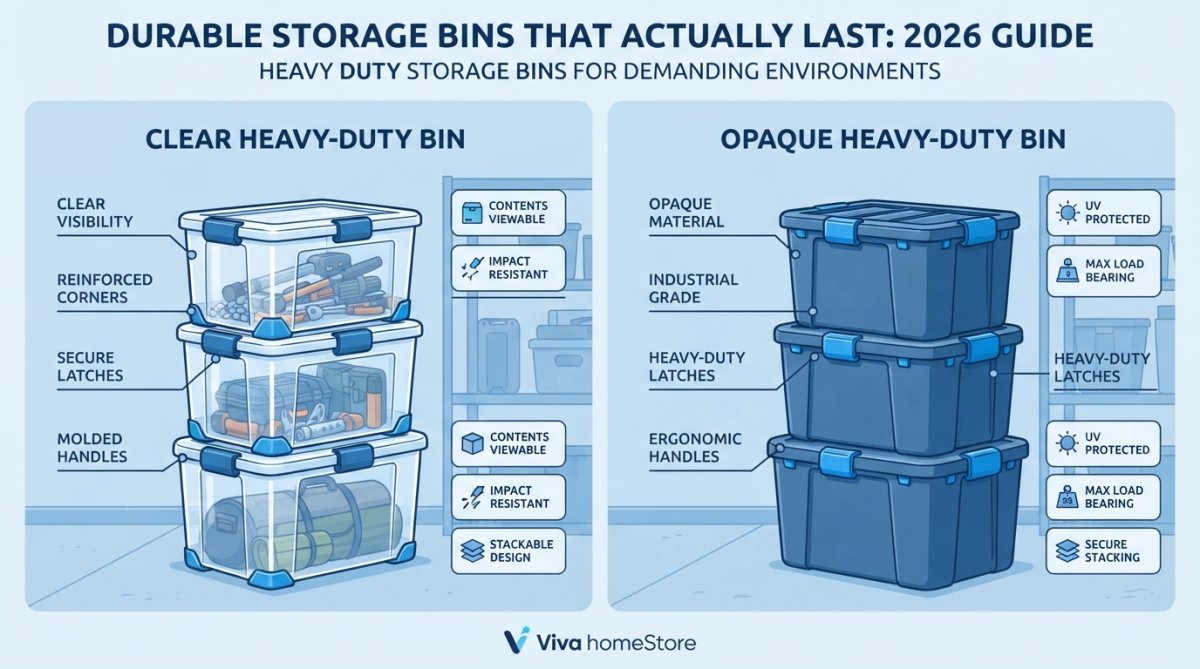
Heavy-duty storage bins hold real weight, survive rough handling, and last through years of garage, basement, or attic use. This means thicker plastic, reinforced structure, and materials chosen specifically for durability rather than cost.
Load-Bearing Capacity and Weight Limits
Every bin has a weight limit, the amount of load it can support stacked on top without deforming or cracking. Real load capacity depends on plastic thickness, internal ribbing pattern, and bin dimensions. The lid contributes to load capacity; a flimsy lid can't support weight without flexing, which breaks the seal or cracks the lid itself. Quality bins use lids with internal reinforcement that prevents sagging under load.
Temperature affects load capacity. Plastic becomes more flexible when warm and more brittle when cold. A bin that safely holds 60 pounds at 70°F might only handle 40 pounds at 30°F. If you're storing bins in an unheated garage or attic, account for seasonal temperature swings when calculating safe load limits.
Stackability and Nesting Features
Stackable bins save space, but stacking creates stress. Bins designed for stacking have reinforced corners and lids that can handle concentrated load. Look for bins with stackable feet or a recessed lid design. Stackable feet create space between the bin and whatever sits below it, allowing air circulation and reducing pressure concentration. A recessed lid sits slightly below the rim, so when you stack another bin on top, the weight rests on the rim, not the lid itself.
The best heavy-duty bins for demanding environments prioritize stacking over nesting because they don't compromise structural integrity for convenience.
Waterproof Outdoor Storage Bins for Long-Term Protection
Moisture is the silent killer of storage bins. Water that seeps in damages contents and accelerates plastic degradation. Waterproof bins require airtight seals, moisture-resistant materials, and design features that prevent water from pooling or seeping.
Gasket Seals and Airtight Latching Lids
The seal is where bins fail. A gasket, a rubber or silicone strip around the lid, creates an airtight seal when the lid is closed. But gaskets degrade. Sun exposure, temperature cycling, and regular use harden the gasket material, reducing its effectiveness. After 3-5 years, many gaskets stop sealing properly.
Quality gaskets use materials that resist UV degradation and maintain flexibility across temperature ranges. Silicone gaskets last longer than rubber ones. The latching mechanism determines whether the seal actually works. Four latches (one on each side) create even pressure across the entire lid. Test the seal by closing the lid and trying to lift the bin by the lid. If the lid lifts with the bin, the seal is tight.
UV Resistance and Moisture Prevention
Sunlight breaks down plastic through photodegradation. UV rays cause the plastic to become brittle and discolored. After 2-3 years in direct sun, many bins become noticeably brittle and prone to cracking. UV-resistant additives slow this process. If you're storing bins outdoors, verify that the manufacturer specifies UV resistance.
Color affects UV resistance. Dark colors absorb more heat and UV radiation, accelerating degradation. Light colors reflect more heat and UV, slowing degradation. A white or light gray bin lasts longer in direct sunlight than a black one. Moisture prevention requires more than a good seal. The bin's design should prevent water from pooling on the lid. A sloped lid sheds water; a flat lid collects it. Drainage holes in the bottom allow water to escape if it does seep in.
Plastic Storage Bins for Extreme Temperatures
Temperature extremes test plastic in ways that moderate conditions never do. A bin that works fine in a climate-controlled home might fail in an unheated garage or a hot attic.
Temperature Tolerance and Material Degradation
Polypropylene has a useful temperature range. Most quality bins handle temperatures from -20°F to 120°F without permanent damage. At temperatures below -10°F, many plastics become so brittle that a moderate impact causes cracking. At temperatures above 110°F, plastic becomes soft and deformable.
Rapid temperature cycling is worse than sustained temperature extremes. A bin that experiences daily swings from 30°F at night to 80°F during the day undergoes stress that a bin in a constant 55°F environment doesn't. The plastic expands and contracts repeatedly, creating micro-cracks that eventually become visible cracks.
High-quality polypropylene formulations include additives that maintain flexibility in cold and resist softening in heat. Budget plastic lacks these additives and fails faster across temperature extremes. If you're storing bins in an unheated garage, attic, or shed, choose bins rated for extended temperature ranges.
Chemical Off-Gassing and Safety Considerations
Plastic releases volatile organic compounds (VOCs) through off-gassing. This is strongest when the plastic is new and decreases over time. Most off-gassing happens in the first few weeks after manufacture. Lower-quality plastics off-gas more than high-quality ones because they contain more additives and volatile components.
For food storage specifically, verify that bins are food-safe and BPA-free. General-purpose storage bins aren't tested for food contact and shouldn't be used for long-term food storage. Temperature increases off-gassing, so store bins in cooler environments and ensure good ventilation.
Storage Bins With Secure Latches That Hold Over Time
Latches fail more often than any other component. They crack, loosen, or wear out. A bin with a broken latch might still be structurally sound, but it's useless if the lid won't stay closed.
Latch Durability and Seal Integrity
Plastic latches are convenient and inexpensive but fail faster than metal ones. Plastic is less durable and more prone to cracking, especially if the latch is thin or poorly designed. Latches that are molded as part of the lid are more durable because they can't separate.
Quality bins use latches designed to withstand thousands of open-close cycles. Test the latch by opening and closing it 20 times quickly. If it feels loose or wiggly, it will fail soon. If it feels solid and clicks firmly into place, it should last. Four latches create more even pressure than two, resulting in a better seal.
Handles, Wheels, and Transport Features
Handles determine whether a bin is actually portable. A handle that's too small causes hand strain. A handle that's too thin breaks under load. Quality bins have handles that are thick enough to grip comfortably and strong enough to support the bin's weight when full. Molded handles are more durable than attached handles.
Some bins have wheels, which transforms them from stationary storage to mobile units. Quality wheels use ball bearings and durable plastic or rubber that resists wear. Polyurethane wheels balance durability with floor protection.
Long-Term Durability: What Testing Reveals
Real durability testing involves stress that storage bins encounter over years of use. This includes temperature cycling, moisture exposure, weight stacking, and impact.
Cracking, Warping, and Common Failure Points
Cracks start small and grow. Most cracks start at stress concentration points: corners, latch attachment points, or where the lid meets the body. Warping happens when plastic deforms under heat or sustained load and doesn't return to its original shape. A warped lid won't seal properly. A warped body won't stack evenly. Warping is usually permanent.
The most common failure points are the corners, the latch attachment areas, the seal area, and the handle attachment points. Bins that reinforce these areas last longer. Seal degradation is insidious because it happens slowly. A bin that sealed perfectly when new gradually loses its seal as the gasket hardens and the latch loosens.
Repair and Maintenance for Extended Lifespan
Most bin failures don't require replacing the entire bin. Gaskets can be replaced. Latches can be reinforced or replaced. Cracks can be sealed. With proper maintenance, a quality bin can last 10+ years.
Inspect bins quarterly for signs of damage. Look for cracks, especially in corners and around latches. Check the gasket for hardening or visible damage. Test the latches to ensure they're still tight. Clean bins regularly, especially if they're stored outdoors. Store bins in the coolest, driest location available. A climate-controlled basement lasts longer than an unheated garage. Shade lasts longer than direct sunlight.
If a gasket hardens and the bin no longer seals, order a replacement gasket from the manufacturer. This costs a fraction of a new bin and restores function completely. For outdoor bins, apply a UV-protective coating every 2-3 years to extend the life of the plastic.
How to Choose Durable Storage Bins That Actually Last for Your Needs
Selecting the right bin requires matching the bin's capabilities to your actual storage environment and use case. A bin perfect for a climate-controlled closet might fail in an attic.
Space-Efficiency and Storage Capacity Planning
Calculate your actual storage needs before buying bins. Measure the space where bins will sit. Account for the space needed to open lids and access contents. Consider vertical stacking and calculate how many bins you'll stack, verifying that the bottom bins can handle the weight.
Nesting bins save space when empty but are less durable than non-nesting bins of the same size. If you need maximum durability, choose non-nesting bins. If space efficiency matters more, choose nesting bins and accept slightly lower durability. Plan for future growth and buy bins slightly larger than your current needs.
| Storage Scenario | Best Bin Type | Key Priority | Expected Lifespan |
|---|---|---|---|
| Climate-controlled closet | Standard plastic bins | Nesting efficiency | 7-10 years |
| Unheated garage | Heavy-duty polypropylene | Temperature tolerance | 5-8 years |
| Outdoor shed | Weatherproof with gasket seal | Moisture resistance | 6-10 years |
| Damp basement | Elevated bins with drainage | Moisture prevention | 4-7 years |
| Hot attic | UV-resistant dark plastic | Heat tolerance | 4-6 years |
| Frequent access | Clear bins with handles | Durability of latches | 6-9 years |
Garage, Basement, and Attic Storage Considerations
Garage storage faces temperature swings and humidity changes. Choose bins rated for extended temperature ranges and with UV-resistant plastic. Store bins on shelving or pallets to keep them elevated above the floor.
Basement storage is typically cooler and more stable than garages, but dampness is a constant concern. Choose bins with excellent seals and store them on elevated shelving. Attic storage is the most extreme environment. Bins stored in attics need to tolerate extreme temperatures and rapid changes. Use bins with excellent seals and ensure good attic ventilation.
For all locations, avoid storing bins directly on concrete floors. Moisture wicks up through concrete and damages the bins and contents. Use shelving, pallets, or wooden platforms to elevate bins at least a few inches above the floor.
Finding durable storage bins that actually last means investing in quality materials, reinforced structure, and proper seals, then maintaining them over years of use. The bins that survive a decade aren't the cheapest ones; they're the ones designed with virgin polypropylene, reinforced corners, quality gaskets, and durable latches. Viva homeStore offers a curated selection of practical storage solutions that balance durability with functionality, helping you organize your home efficiently without replacing bins every few years. When you choose bins rated for your actual environment, accounting for temperature swings, moisture exposure, and weight loads, you're not just buying storage; you're investing in a system that keeps your belongings protected and your spaces organized for years to come.
Frequently Asked Questions
What material makes durable storage bins that actually last longer?
Polypropylene is the industry standard for durable storage bins due to its impact resistance and structural integrity. High-quality polypropylene resists cracking and warping in both hot and cold temperatures. Look for bins labeled as heavy-duty or industrial-grade, which use thicker plastic walls and reinforced corners. Avoid thin-walled bins that degrade quickly under UV exposure or temperature fluctuations.
How do secure latches and gaskets prevent moisture damage in waterproof outdoor storage bins?
Airtight latching lids with rubber gaskets create a moisture-resistant seal that protects contents from humidity, dust, and water infiltration. Quality gaskets maintain their seal integrity over years of opening and closing. When selecting waterproof outdoor storage bins, verify that latches lock firmly and gaskets show no cracking or brittleness. Regular inspection ensures the seal remains effective for long-term storage protection.
What weight capacity should I look for in heavy duty storage bins?
Heavy duty storage bins typically support 50-150 lbs per unit, depending on design and material thickness. Check the manufacturer's weight limit before stacking multiple bins, as exceeding capacity causes structural failure and cracking. Consider both the contents' weight and the stress from stacking, a bin rated for 100 lbs may only safely stack to half that when loaded. Stackability features and load-bearing limits are critical for garage and basement storage.
Can plastic storage bins withstand extreme temperatures without warping or cracking?
Quality plastic storage bins for extreme temperatures are engineered to resist degradation from -40°F to 120°F or beyond. However, rapid temperature changes cause expansion and contraction, leading to warping over time. Polypropylene bins handle temperature swings better than polyethylene. Avoid placing bins in direct sunlight for extended periods, as UV exposure accelerates material brittleness and cracking, especially in extreme climates.
What are common mistakes that reduce storage bin lifespan?
Overloading bins beyond weight limits causes permanent warping and structural damage. Stacking bins incorrectly prevents proper weight distribution and can collapse under pressure. Exposing bins to prolonged UV rays degrades plastic faster than expected. Failing to maintain gasket seals allows moisture intrusion, leading to mold and corrosion inside. Store bins in climate-controlled areas when possible, inspect latches regularly, and avoid dragging bins across rough surfaces to maximize durability.
This article was written using GrandRanker