

Durable Storage Bins With Wheels: 2026 Reviews
Table of Contents
- What Makes Durable Storage Bins With Wheels Worth Your Investment
- Heavy Duty Rolling Storage Totes: Features That Matter
- Storage Bin Weight Capacity: How to Choose the Right Load Limit
- Top Performers: Durable Storage Bins With Wheels Reviewed
- Maintenance and Wheel Durability: Keeping Your Totes Rolling
- Floor Surface Compatibility and Weight Distribution
- Verdict: Which Storage Bin Fits Your Needs
- Frequently Asked Questions
Last Updated: September 30, 2026
What Makes Durable Storage Bins With Wheels Worth Your Investment
Durable storage bins with wheels solve a fundamental problem: organizing without sacrificing mobility. The difference between a bin that fails after two years and one that lasts a decade comes down to material quality, weight capacity, and wheel durability.
The right durable storage bins with wheels eliminate friction from retrieval and restocking, turning organization from a chore into a reliable system.
Three core factors separate the best performers: industrial-grade construction that resists cracking, load-bearing capacity matching your needs, and wheels engineered for rough surfaces.
Heavy Duty Rolling Storage Totes: Features That Matter
Industrial-grade storage totes feature reinforced polypropylene or polyethylene construction, steel-wire or rubber wheels rated for sustained loads, and latching mechanisms that stay secure through hundreds of cycles.
Polypropylene vs. polyethylene: Polypropylene resists cracking in cold temperatures, critical for garage or outdoor storage. Polyethylene offers superior impact resistance but can become brittle below freezing. For year-round use, polypropylene wins.
Soft rubber casters grip uneven concrete; hard plastic wheels roll smoothly on smooth surfaces but skip on rough terrain. The best totes use dual-material wheels: rubber treads for grip, hard cores for durability.
360-degree swivel casters let you maneuver tight corners without lifting. Fixed wheels are cheaper but less practical in cluttered spaces.
Locking casters prevent drift when bins sit loaded, essential if stacking or parking on slopes.
Foam gaskets or rubber seals protect contents from dust and moisture. Buckle latches compress seals tighter than snap-fit lids.
Recessed side handles prevent knuckle scrape; lid-only handles force awkward angles when bins are full.
Storage Bin Weight Capacity: How to Choose the Right Load Limit
Weight capacity determines whether a bin functions or cracks under load. Residential totes range from 50-150 pounds; industrial models exceed 200 pounds.
Calculate actual needs: holiday decorations weigh ~80 pounds, power tools ~120 pounds, canned goods can exceed 150 pounds.
Overloading one corner or stacking beyond rated limits risks wheel failure and structural cracking.
Choose a bin rated 25-30% above anticipated load. A 150-pound tote handles 100-120 pounds safely, preventing stress fractures and extending wheel life.
Check stacking guidelines, some totes stack 3-4 high, others cap at 2. Exceeding limits crushes wheels and warps the base.
Top Performers: Durable Storage Bins With Wheels Reviewed
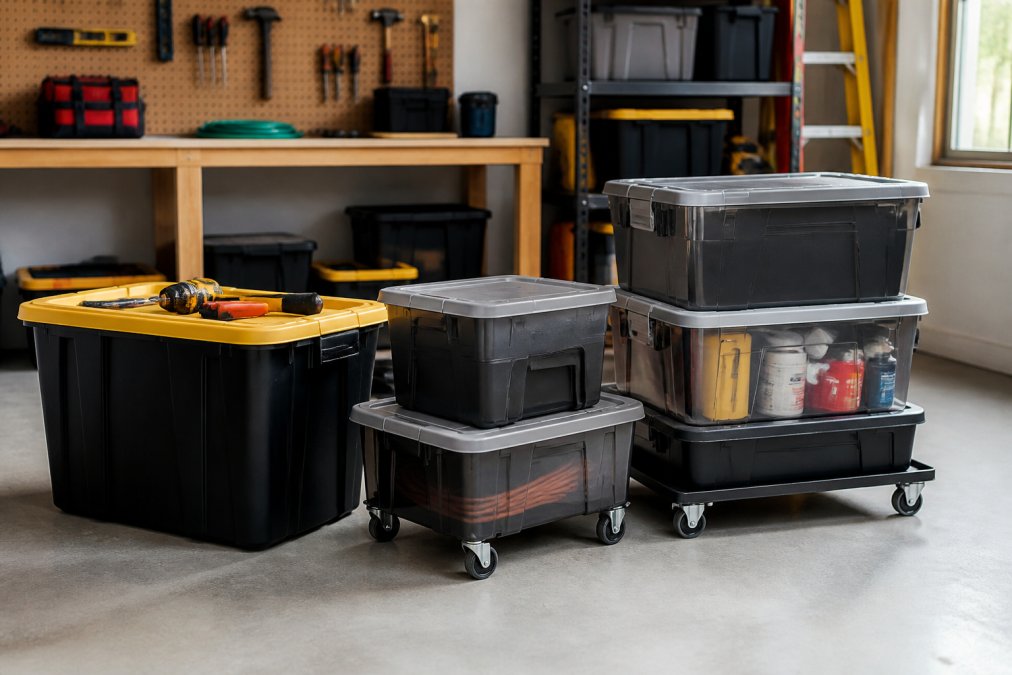
Industrial-Grade Options for Demanding Spaces
Iris USA 40 Gallon Wheeled Industrial Tote leads the heavy-duty category with 40-gallon capacity, reinforced lid, and stackable design. Trade-off: large footprint won't fit standard closets.
Rubbermaid Roughneck Wheeled Storage Tote excels in extreme temperatures, resisting cracking where cheaper alternatives fail. Drawback: opaque construction makes inventory difficult.
Budget-Friendly Models That Don't Sacrifice Durability
HDX 102L Tough Tote with Wheels offers impact-resistant polypropylene at a fraction of industrial-tote costs. Limitation: lid latches are stiff initially.
Homz Durabilt Wheeled Storage Tote balances weight and strength with ergonomic handles and secure latching. Trade-off: smaller wheels cause more friction on rough surfaces.
Sterilite Wheeled Latching Box serves closet and bedroom organization with clear visibility and integrated wheels. Residential-grade for lighter loads and controlled environments.
Weathertight Designs for Moisture-Sensitive Storage
Iris Weathertight Wheeled Storage Box protects sensitive items with foam seal and buckle latches. Consideration: seal requires careful alignment to maintain integrity.
Commander 27 Gallon Wheeled Tote handles demanding environments with rugged wheels and reinforced lid. Limitation: lid can be difficult to snap on if misaligned.
Maintenance and Wheel Durability: Keeping Your Totes Rolling
Understanding why wheels fail helps you extend bin life by years through routine inspection and maintenance.
Wheel jamming occurs when dirt accumulates in the caster housing. Hard plastic wheels develop flat spots under prolonged heavy loads; rubber wheels resist flat-spotting but can crack in freezing temperatures.
Preventive maintenance schedule:
- Every 3 months: Inspect wheels for debris and rotate by hand to confirm smooth movement.
- Every 6 months: Clean axle housing with a brush to remove concrete dust and salt residue.
- Annually: Check latches for cracks; replacement kits cost $5-12.
- As needed: If a wheel wobbles, the caster axle may be bent from dragging or uneven loading.
Wheel replacement and repair:
Replacement wheel sets cost $8-20 and install in under 5 minutes, extending bin life 3-5 years. Match wheel types (rubber vs. plastic) when replacing single casters to prevent pulling to one side.
Wipe gaskets clean before closing lids, debris prevents full compression. If moisture appears inside sealed bins, gaskets have failed. Replacement kits cost $6-15 and install in 10 minutes.
Handles crack when bins are lifted by the lid alone. Always grip side handles or the base to distribute weight and prevent stress fractures.
Replace wheels ($8-20), gaskets ($6-15), or latches ($5-12) individually. If the base cracks from overstacking, replace the bin. Bins requiring multiple repairs after 5+ years are nearing end-of-life.
Floor Surface Compatibility and Weight Distribution
Floor surface, wheel type, and weight distribution determine whether bins roll smoothly for years or fail prematurely.
Floor surface and wheel compatibility:
| Surface Type | Ideal Wheel Material | Why It Matters | Best Bin Option |
|---|---|---|---|
| Smooth concrete (sealed garage) | Hard plastic or rubber | Wheels roll freely without resistance; no grip needed | Any model; budget options work fine |
| Rough/uneven concrete (unsealed) | Rubber with soft treads | Grip prevents skipping on bumps; soft material absorbs impact | Heavy-duty industrial totes (Iris, Rubbermaid) |
| Garage floors with oil/residue | Rubber or polyurethane | Grip prevents slipping on slick surfaces; hard plastic wheels lose traction | Rubbermaid or Iris industrial models |
| Tile or smooth indoor floors | Hard casters for smooth rolling | Soft wheels stick and require more force; hard wheels glide | Budget or mid-range models (HDX, Homz) |
| Outdoor/uneven terrain | Large soft-rubber wheels (3+ inches) | Absorbs impact from gravel, grass, and ruts; prevents tipping on uneven ground | Industrial-grade with reinforced casters |
| Basement with moisture/humidity | Rubber wheels (avoid hard plastic) | Hard plastic becomes slick when damp; rubber maintains grip | Weathertight models with rubber casters |
Rough surfaces wear wheels faster; expect replacement every 2-3 years. For uneven or outdoor storage, invest in larger wheels (3-inch) and soft-tread materials, the upfront cost difference pays for itself.
Weight distribution and tipping prevention:
Weight distribution matters more than total weight. A 120-pound load spread evenly causes minimal stress; the same weight stacked on one side creates tipping risk.
Safe loading principles:
- Place heavy items at the bottom center to distribute weight equally and lower center of gravity.
- Distribute weight side-to-side and top-to-bottom to prevent tipping.
- Don't exceed 70% of rated capacity if the bin will be tilted or moved frequently.
- Load in the order you'll unload to maintain stability.
- Use dividers ($3-8) to prevent items from shifting.
Tipping risk assessment:
Tall, narrow bins have higher tipping risk.
Wheel stress under uneven loading:
- Accelerated wear on loaded-side wheels. They flatten faster and may fail 1-2 years earlier than opposite wheels.
- Pulling to one side. The bin naturally drifts toward the lighter side, making it harder to push straight.
- Bent caster axles. If a wheel is overloaded and hits a bump, the axle can bend, causing permanent wobbling.
Real-world loading scenarios:
Verdict: Which Storage Bin Fits Your Needs
For serious garage and workshop storage: Iris USA 40 Gallon Wheeled Industrial Tote delivers capacity and durability. The investment pays off through years of reliable performance.
Frequently Asked Questions
How much weight can heavy-duty rolling storage bins hold?
Weight capacity varies significantly by model. Industrial-grade options like the Iris USA 40-Gallon Wheeled Tote and Rubbermaid Roughneck handle loads of 200-300 pounds when properly distributed. Mid-range models typically support 150-200 pounds. Always check the manufacturer's specifications before loading, as exceeding capacity risks wheel damage and structural failure. Distribute weight evenly across the base to prevent tipping and premature wear on casters.
What features should I look for in a durable storage bin with wheels?
Prioritize heavy-duty polypropylene or reinforced plastic construction, 360-degree swivel casters for smooth mobility, and secure locking mechanisms on lids. Look for stackable designs with reinforced corners and bases. Weathertight seal integrity matters if storing outdoors or in damp garages. Handle ergonomics and wheel quality directly affect long-term usability. Impact-resistant materials prevent cracking from drops and temperature extremes.
Are weathertight storage bins worth the extra cost?
Yes, if you store items sensitive to moisture, dust, or temperature fluctuations. Weathertight models with foam-seal latches protect contents from humidity, pests, and environmental damage. They cost slightly more upfront but extend the life of stored goods and prevent mold and rust. For garage, basement, or attic use, the seal integrity protects valuable items and justifies the investment. Non-weathertight options work fine for dry indoor closets.
Which storage bin material lasts the longest?
Heavy-duty polypropylene and reinforced plastic both offer excellent long-term durability when manufactured to industrial standards. Look for models with UV-resistant formulations to prevent cracking from sunlight. Steel-wire reinforcement in corners and base areas adds structural strength. Rubbermaid and Iris models consistently resist temperature extremes and physical impact. Material thickness and construction quality matter more than material type alone.