

How to Maximize Closet Space in a Small Bedroom
Table of Contents
- Step 1: How to Declutter a Small Closet Before You Organize
- Step 2: Small Closet Organization Ideas That Use Vertical Space
- Step 3: The Best Closet Organizers for Small Spaces
- Step 4: How to Maximize Closet Space With Bins, Dividers, and Labels
- Step 5: Shoe Storage and Floor-Level Space Optimization
- Step 6: Lighting, Paint, and Visual Clutter Reduction
- Step 7: Seasonal Rotation and Inventory Management for a Small Bedroom Closet
- Frequently Asked Questions
Last Updated: September 12, 2026
Step 1: How to Declutter a Small Closet Before You Organize
Before you buy a single bin or hanger, empty the closet completely. Most people try to organize around clutter, which is why the closet stays crowded no matter how many organizers they add. Learning how to maximize closet space in a small bedroom starts with subtraction, not addition.
Pull everything out and sort it into four boxes:
- Keep: Items worn in the past year that fit and you actually like
- Donate: Good condition, wrong size, or never worn
- Repair: Needs a button, a hem, or a cleaning before it earns its place
- Toss: Stained, stretched, or damaged beyond use
The keep box is almost always smaller than expected. That gap is your real storage gain.
Step 2: Small Closet Organization Ideas That Use Vertical Space
Small closet organization ideas work best when they treat the closet as a column, not a floor. Most closets waste the top third and the bottom third, leaving the middle crammed. Vertical storage fixes that imbalance.
Double-Hanging and Cascading Hangers
Add a second rod below your existing one to create double-hanging space for shirts, skirts, and folded trousers. Cascading hangers stack several garments on one hook, which frees the rod for longer items like coats and dresses. Slimline hangers take up a fraction of the width of wooden ones, so the same rod holds noticeably more.
Tension Rods and Wire Shelving Add-Ons
Tension rods install without drilling and work well inside narrow closets or under an existing shelf. Wire shelving add-ons clip onto your current system to create stacking space above the rod. Both are reversible, which matters if you rent.
Step 3: The Best Closet Organizers for Small Spaces
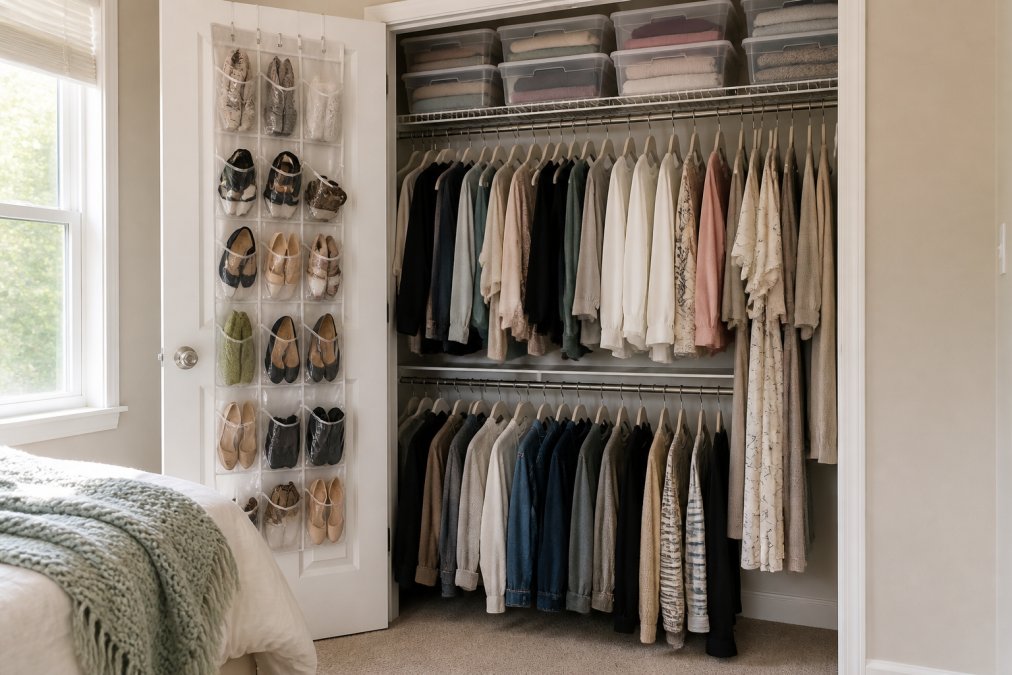
The best closet organizers for small spaces are the ones that use surfaces you already have: the door, the wall, and the space above the rod. These three zones are usually empty in a small bedroom closet. But picking the right organizer is not about buying the most popular type, it is about matching the hardware to your closet's actual dimensions, your wall construction, and how much weight the item will carry.
Measure Before You Buy
Before any purchase, take four numbers: the closet's interior width, its depth (front wall to back wall), the height from floor to the existing rod, and the height from the rod to the ceiling or shelf above. A standard reach-in closet is roughly 24 inches deep and 6 to 8 feet wide, but older homes vary widely (homes.com). Those four numbers tell you which organizers will actually fit:
- Double-hang conversion: You need at least 40 inches of vertical space below the existing rod to add a second rod. Shirts need about 24 to 28 inches of drop; folded trousers and skirts need 30 to 36 inches. If you have less than 40 inches, a second full rod will crush the clothes below it.
- Over-the-door racks: Measure the door thickness first. Most over-the-door brackets fit doors between 1 3/8 and 1 3/4 inches thick (homedepot.com). A hollow-core bedroom door can handle a lightweight fabric organizer but will bow under a loaded wire rack.
- Wall-mounted rails: You need to know what is behind the drywall. A stud finder tells you where you can anchor a rail that holds bags or coats. Without a stud, use hollow-wall anchors rated for the load, a rail holding purses can easily exceed 20 pounds.
Over-the-Door and Wall-Mounted Options
Over-the-door organizers turn the back of the closet door into shelving for shoes, scarves, and accessories. Fabric versions with clear pockets are the lightest and safest for hollow-core doors; wire or metal versions hold more weight but need a solid or reinforced door. Wall-mounted hooks and rails hold belts, bags, and robes without eating rod space, and they work best on the side wall rather than the back wall so they do not collide with hanging clothes. Shelf dividers keep folded stacks from toppling into each other and are the cheapest fix for a shelf that has turned into a landslide.
Tension Rods, Cascading Hangers, and Slimline Hangers
A tension rod installs without drilling and works well inside narrow closets or under an existing shelf. The trade-off is load: a tension rod holding heavy winter coats will slip, so reserve it for shirts, skirts, and lightweight layers. Cascading hangers stack several garments on one hook, which frees the rod for longer items like coats and dresses, but each hook adds bulk, so they work best on a rod with at least 12 inches of clear vertical space above it. Slimline hangers take up a fraction of the width of wooden ones, so the same rod holds noticeably more; a velvet or rubberized slimline also grips fabric and stops straps from sliding off.
How the Main Organizer Types Compare
| Organizer | Best For | Space Gained | Key Trade-Off |
|---|---|---|---|
| Over-the-door rack | Shoes, accessories | Door surface | Adds door weight; check door thickness |
| Tension rod | Narrow or rental closets | Extra hanging row | Slippage under heavy loads |
| Cascading hangers | Shirts, skirts | Rod width | Adds bulk; needs vertical clearance |
| Slimline hangers | All hanging clothes | Rod width | Less sturdy for heavy coats |
| Shelf dividers | Folded stacks | Vertical order | Only works on existing shelves |
| Wall-mounted hooks | Bags, robes, belts | Wall surface | Needs studs or rated anchors |
The Unique Angle: A DIY vs. Permanent Decision Framework
Most guides tell you to buy organizers without asking whether the upgrade should be temporary or permanent. Use this rule of thumb:
- Renters or anyone planning to move within two years: Stick to tension rods, over-the-door racks, and freestanding stackable units. They leave no holes and move with you.
- Owners staying put: A wall-anchored rail, a second permanent rod, and a wire or melamine shelf system cost more upfront but hold far more weight and never slip. The break-even point is usually the second time you would have replaced a failed tension rod.
If you are unsure, start with the reversible options, live with them for a season, and only drill once you know exactly where the load lands.
Step 4: How to Maximize Closet Space With Bins, Dividers, and Labels
Bins and dividers convert awkward gaps into usable storage. A shelf with loose items wastes the space above and beside each object; a bin captures all of it. Clear bins let you see contents without opening them, which cuts the daily rummaging that slowly wrecks an organized closet. But the difference between a bin system that lasts and one that collapses in a month is whether you sized the bins to the shelf and defined what belongs in each one before you filled it.
Size the Bin to the Shelf, Not the Other Way Around
Measure your shelf depth and height before buying anything. A standard closet shelf is 12 to 14 inches deep, so a bin deeper than that will hang off the edge or block the rod below (lowes.com). Leave at least 2 inches of clearance above the tallest bin so you can lift it out without scraping the shelf above. Rectangular bins waste less space than round ones on a rectangular shelf, the corners are free storage. For a deep shelf, a lazy susan or a pull-out bin brings the back row into reach instead of leaving it as a graveyard for things you forgot you owned.
Group by Category, Then by Frequency
Group by category, not by color: workout gear in one bin, off-season knitwear in another, small accessories in a third. Then layer by how often you touch each category:
- Daily items at eye level and within arm's reach
- Weekly items on the shelf just above or below eye level
- Seasonal or occasional items on the top shelf or in under-bed storage
This frequency layering is what makes a small closet feel bigger, you are not fighting past rarely used items to reach the ones you wear every day.
Label the Front Edge, Not the Top
Label each bin on the front edge so the system survives contact with a busy household. A label on top disappears the moment you stack a second bin. Use a consistent label format, category name plus a short contents note, so anyone in the household can put things back correctly. Drawer inserts do the same job for a built-in dresser: they stop small items from sliding into a single undifferentiated pile.
The Unique Angle: A Simple Inventory System That Prevents Re-Buying
Most guides stop at labels. The real reason small closets re-clutter is that people buy duplicates of things they already own but cannot see. A lightweight inventory fixes that without an app subscription:
- Photograph each bin's contents after you fill it. Keep the photos in a single phone album named for the closet.
- Write a one-line index on a note card taped inside the closet door, bin number, category, and a short contents list.
- Check the index before you shop. If the card says you already own three black cardigans, you do not need a fourth.
- Update the card during seasonal rotation. When you swap winter for summer, rewrite the affected lines. The card stays accurate because it only changes twice a year.
If you prefer a digital version, a simple spreadsheet or a notes app works the same way, the point is a single source of truth you actually check. This is the step most closet guides skip, and it is the one that keeps a small closet from slowly refilling with duplicates.
Step 5: Shoe Storage and Floor-Level Space Optimization
Shoe storage is where most small closets lose the battle. Pairs get kicked into a pile, and the floor disappears. Keep shoes on a rack, in stackable clear boxes, or on an over-the-door shoe organizer so the floor stays clear for laundry baskets or a small stool.
For very tight rooms, under-bed storage takes the overflow. Rotate only the current season's shoes into the closet and store the rest in flat boxes under the bed. This keeps the closet floor as working space rather than a shoe graveyard.
Step 6: Lighting, Paint, and Visual Clutter Reduction
A dark closet reads as smaller and fuller than it is. Add a battery-powered LED strip or a stick-on puck light so you can see the back of the shelf. Light-colored paint on the closet walls bounces that light and makes the space feel wider.
Visual clutter is the real enemy here. Matching hangers, uniform bins, and a single color palette make a packed closet look calm instead of chaotic. Reducing what you see reduces the feeling of crowding, even when the square footage has not changed.
Step 7: Seasonal Rotation and Inventory Management for a Small Bedroom Closet
Seasonal rotation keeps a small closet working year-round. Twice a year, move off-season clothing into labeled under-bed bins and bring the current season forward. This is the step most guides skip, and it is the one that decides whether your closet stays functional in January and July alike.
Pair rotation with a simple inventory. Keep a running list of what you own by category, and check it before you shop. Inventory management stops the slow re-accumulation that undoes a good purge. It also makes accessibility easier: heavy items on lower shelves, daily items at eye level, and rarely used pieces up high.
Frequently Asked Questions
What is the best way to organize a tiny closet?
Start by decluttering, then work upward. Use double-hanging rods to create two levels of hanging space, add over-the-door organizers for shoes and accessories, and group like items into labeled bins. Slimline and cascading hangers free up several inches of rod space. Finish with a seasonal rotation so only current clothing stays in the closet. This layered approach lets a small closet hold far more without feeling crowded.
How can I add more hanging space to a small closet?
Install a second tension rod below your existing one to create double-hanging space for shirts, skirts, and folded pants. Cascading hangers let you stack multiple garments on a single hook, and slimline hangers reduce bulk on the main rod. An over-the-door rack adds hanging room without touching the closet interior. Together these changes can noticeably expand usable hanging space in a small bedroom closet.
How do you store shoes in a small closet without taking up floor space?
Move shoes off the floor and onto the back of the door or the wall. Over-the-door shoe organizers hold 12 to 24 pairs in a few inches of depth. Wall-mounted racks and clear stackable shoe boxes use vertical space instead of floor area. For under-bed storage, flat boxes on wheels work well for off-season pairs. Keeping the closet floor clear makes the whole space feel larger and easier to clean.
How do I maximize vertical space in a closet?
Measure from floor to ceiling and install shelving or rods all the way up. The top shelf, often wasted, is ideal for bins holding off-season items. Double-hanging rods turn one tall section into two shorter ones. Stacked bins and shelf dividers keep upper shelves usable. A floor-to-ceiling approach typically recovers more storage than any single product, so start by looking at what sits above eye level.
A small bedroom closet only stays organized when the system fits your actual routine, not a magazine photo. At Viva homeStore, we carry the practical pieces that make that system work: space-saving organizers, lighting to brighten a dark closet, and storage furniture built for compact rooms. Our curated selection focuses on functionality first, so every item earns its place. Shop now at Viva homeStore and turn your crowded closet into a space that works for your family every day.