

Maximize Kitchen Cabinet Space: 7 Proven Strategies
Table of Contents
- Assess Your Current Cabinet Setup and Storage Capacity
- Use Shelf Risers and Tiered Shelving to Maximize Vertical Space
- Install Pull-Out Shelves for Kitchen Cabinets
- Organize Corner Cabinet Storage Ideas
- Maximize Under Sink Cabinet Organizers
- Build DIY Kitchen Cabinet Organizers on a Budget
- Optimize Cabinet Doors and Wall-Mounted Storage
- Choose Stackable Containers and Drawer Dividers
Last Updated: July 23, 2026
When it comes to kitchen organization, learning how to maximize kitchen cabinet space is one of the most effective ways to transform your home. At Viva homeStore, we help homeowners tackle one of the most common household challenges: making every inch of cabinet storage count. Below, we'll show you exactly how to maximize kitchen cabinet space through seven proven approaches that range from simple organizational tweaks to strategic storage solutions.
According to the National Association of Professional Organizers, the average household wastes approximately 40% of available cabinet storage capacity through poor organization and underutilized vertical space.
Assess Your Current Cabinet Setup and Storage Capacity
Before you buy a single organizer, understand what you're working with. Most people skip this step and jump straight to purchasing products, then wonder why their solutions don't fit.
Measure Cabinet Depth and Weight Capacity
Measure the exact depth of your cabinets from the front opening to the back wall. Check the weight capacity of your shelves, most standard cabinet shelves support 25 to 50 pounds when evenly distributed. Open each cabinet door and look at the shelf supports to note their spacing and condition, as damaged supports reduce weight capacity.
Declutter Before Organizing
You cannot maximize kitchen cabinet space if you're storing items you don't use. Go through each cabinet and remove everything. Sort items into three categories: keep, donate, and discard. Apply the "one year rule": if you haven't used something in a year, you don't need it taking up space. Once you've decluttered, you'll have a clearer picture of what actually needs to be stored.
Use Shelf Risers and Tiered Shelving to Maximize Vertical Space
The biggest waste in most kitchen cabinets is vertical space. Shelf risers instantly double your usable storage capacity by creating a second level.
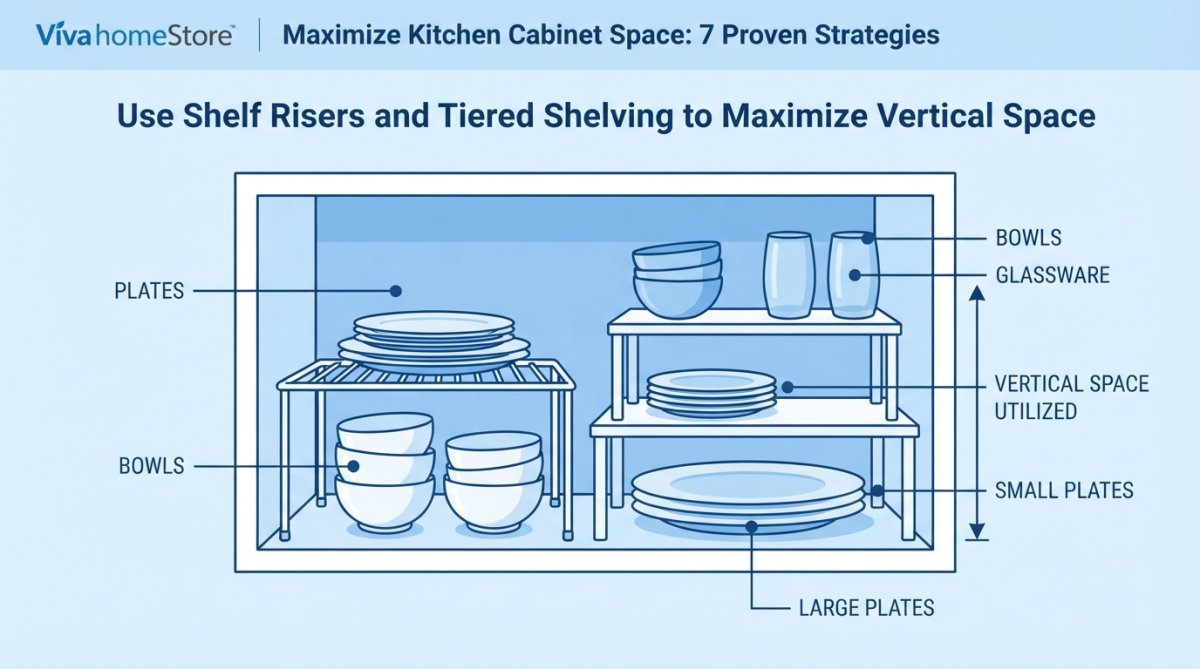
Shelf risers work by creating a second shelf within the same cabinet space. Standard risers come in heights ranging from 6 to 12 inches. Measure your cabinet height from the existing shelf to the shelf above and subtract 2 inches for clearance. Tiered shelving systems offer a more sophisticated approach, creating graduated steps that allow you to see and access items at multiple levels without stacking them directly on top of each other.
Installation Safety and Weight Distribution
Distribute weight evenly across the riser. Most quality risers support 50 to 75 pounds. Ensure the riser sits flat on the shelf below, any wobbling indicates an uneven shelf or improper fit.
Install Pull-Out Shelves for Kitchen Cabinets
Pull-out shelves transform cabinet accessibility by bringing everything within arm's reach instead of requiring you to reach blindly to the back of a deep cabinet. Pull-out shelves come in two types: retrofit kits that attach to your existing shelves, and replacement shelves that replace your current shelves entirely. Retrofit kits are easier to install and typically take 30 to 45 minutes per shelf with basic tools.
DIY vs. Professional Installation
If you're comfortable with basic tools, DIY installation saves money. A retrofit pull-out shelf kit costs between budget-friendly and moderate pricing depending on quality and size. Professional installation adds labor costs but guarantees proper alignment and functionality, particularly valuable for older cabinets with uneven shelves.
Organize Corner Cabinet Storage Ideas
Corner cabinets are notoriously difficult to use efficiently because the corner itself is hard to access and items stored there tend to get forgotten.
Turntables and Lazy Susans for Accessibility
A turntable, also called a Lazy Susan, is a rotating circular shelf that brings items from the back of the cabinet to the front with a simple spin. Place your turntable in the corner and load it with items you use regularly: oils, vinegars, spice bottles, canned goods, or small appliances. Turntables come in various sizes, 12, 15, and 18 inches are common. Most turntables support 50 to 100 pounds and require no installation; you simply place it on the existing shelf and load it.
Maximize Under Sink Cabinet Organizers
The space under the sink is one of the most valuable areas in your kitchen, yet it's often underutilized. Start by measuring the usable space and accounting for pipes, the garbage disposal, and any other permanent fixtures.
Under-shelf baskets that hang from the shelf above create additional storage without taking up valuable floor space. Tension rods installed horizontally can hold spray bottles by their handles, keeping them upright and accessible. A pull-out shelf designed for under-sink cabinets solves the accessibility problem.
Maintenance and Cleaning Considerations
The under-sink area requires more maintenance because of moisture and potential leaks. Check regularly for water damage or mold growth. Line the bottom of the cabinet with a waterproof mat or shelf liner to catch small leaks before they damage the cabinet floor. Avoid storing items directly on the cabinet floor if possible.
Build DIY Kitchen Cabinet Organizers on a Budget
You don't need to spend a fortune to organize your kitchen cabinets effectively. Many of the best solutions cost under $20.
Cost-Effective Materials and Tools
Stackable plastic containers in various sizes provide customizable storage for everything from baking supplies to snack foods. Clear containers let you see what's inside without opening them and cost $3 to $8 per container.
Tension rods, the rods used to hang curtains, can be repurposed inside cabinets to hang spray bottles, measuring cups, or kitchen towels for $5 to $10 and install in seconds with no tools required.
Drawer dividers made from plastic or bamboo organize utensils, flatware, and small items within larger drawers or shelves for $5 to $15. Adhesive-backed shelf liners protect cabinet shelves from moisture and spills while adding a finished look for $8 to $15 per roll. For hanging storage on the inside of cabinet doors, adhesive hooks or small shelves cost $10 to $20 and don't require drilling.
Common Mistakes to Avoid When Organizing
The biggest mistake is buying organizers before you've decluttered. Another common error is choosing organizers that are too tall or too deep for your cabinet space. Overloading shelves with heavy items is frequent, just because you have vertical space doesn't mean you should use all of it. Failing to label containers is surprisingly common; within a few weeks, you'll forget what's in that opaque container. Finally, don't organize in a way that makes items hard to access.
Optimize Cabinet Doors and Wall-Mounted Storage
Cabinet doors represent unused vertical space in most kitchens. The inside of a cabinet door is perfect for lightweight items that you access frequently.
Cabinet Door Organizers and Mug Hooks
The simplest cabinet door organizer is an adhesive hook or small shelf costing $5 to $15 and installing in seconds with no drilling required. Over-the-door organizers designed for pantry doors work equally well inside cabinet doors and typically cost $15 to $30.
Mug hooks mounted on the inside of cabinet doors create dedicated mug storage without taking up shelf space. A set of four hooks costs $8 to $15. The key to cabinet door storage is weight, stick to lightweight items like mugs, towels, measuring spoons, and spice jars.
Wall-Mounted Racks and Rails for Kitchen Workflow
Wall-mounted storage on your kitchen walls extends your storage capacity dramatically, particularly valuable in small kitchens where cabinet space is limited.
Wall-mounted magnetic spice racks hold metal spice containers and keep frequently used spices visible and accessible for $20 to $50. Pegboard panels mounted on walls create infinitely customizable storage for pots, pans, measuring cups, and utensils using hooks and shelves designed for pegboard, costing $20 to $40 with hooks at $1 to $3 each. Floating shelves mounted on walls provide visible storage for cookbooks, decorative bowls, or frequently used ingredients for $20 to $60 per shelf depending on size and material.
Choose Stackable Containers and Drawer Dividers
Stackable containers transform loose items into organized, space-efficient storage. Clear plastic containers let you see contents at a glance, preventing the common problem of buying duplicates. Containers with snap-lock lids keep food fresh and prevent spills.
Stackable containers work particularly well for dry goods like flour, sugar, pasta, and rice; snack foods and cereal; spices and seasonings; and small appliance accessories.
Drawer dividers organize flatware, utensils, and small items within drawers. Modular dividers adjust to fit various drawer sizes. A set of adjustable dividers costs $15 to $30 and can be used in multiple drawers.
| Storage Solution | Best Use | Cost Range | Installation |
|---|---|---|---|
| Shelf risers | Double cabinet shelf capacity | $15-$40 | No tools required |
| Pull-out shelves | Deep cabinet accessibility | $30-$100 per shelf | Basic tools |
| Turntables | Corner cabinet organization | $15-$50 | No installation |
| Stackable containers | Dry goods organization | $20-$60 per set | No installation |
| Tension rods | Hanging lightweight items | $5-$15 | No tools required |
| Wall-mounted shelves | Additional storage | $30-$80 per shelf | Basic tools, wall studs |
| Drawer dividers | Flatware and utensil organization | $15-$30 | No installation |
| Cabinet door organizers | Door-mounted lightweight storage | $15-$40 | Adhesive strips |
Maximizing kitchen cabinet space isn't about buying the most products or the fanciest organizers. It's about understanding your specific cabinet layout, eliminating items you don't use, and strategically placing storage solutions that work with your kitchen's unique dimensions and your daily workflow.
At Viva homeStore, we recognize that every kitchen is different, and that's why we offer a curated selection of practical storage solutions designed to fit real homes and real kitchens. From shelf risers and pull-out systems to stackable containers and wall-mounted organizers, Viva homeStore provides the tools you need to reclaim wasted space and create a more functional kitchen environment. Start with a single high-impact solution, like shelf risers for your most-used cabinet, and build from there. The Container Store's kitchen organization guide and IKEA's cabinet storage solutions offer additional product inspiration if you want to explore options beyond what's available through Viva homeStore. Shop now and discover how simple organization can save you time every single day.
Frequently Asked Questions
How can I maximize kitchen cabinet space without removing cabinets?
Start by decluttering items you don't use regularly. Then implement vertical space solutions like shelf risers, tiered shelving, and stackable containers. Add under-shelf baskets, install cabinet door organizers, and use turntables in corners for better accessibility. Pull-out shelves and drawer dividers optimize cabinet depth and workflow. These solutions help you maximize kitchen cabinet space efficiently without renovation costs or structural changes.
What's the best way to organize deep kitchen cabinets?
For deep cabinets, use pull-out shelves or sliding drawer systems to access items at the back easily. Install tiered shelving or shelf risers to create multiple storage levels. Add tension rods to organize pot lids vertically. Use stackable, modular containers to group similar items and maximize square footage. Lazy Susans work well in corners. Label everything clearly so items don't get lost. Consider the cabinet's weight capacity before installing heavy-duty systems.
How do I organize pots and pans in a small cabinet?
Use vertical pot lid racks mounted inside cabinet doors to free up shelf space. Stack pans using shelf risers or tiered organizers to create multiple levels. Install tension rods horizontally to hang pan handles. Stackable pan racks maximize storage capacity without taking up extra square footage. Group similar-sized pans together using drawer dividers or customizable inserts. Ensure your cabinet's weight capacity supports the pans before installing any system.
What are the best budget-friendly DIY kitchen cabinet organizers?
DIY options include tension rods for hanging items, cardboard dividers for drawer organization, and repurposed containers for stackable storage. Adhesive hooks on cabinet doors cost little and add functionality. Wooden crates or baskets from discount retailers serve as under-shelf storage. Tension rods between shelves organize pot lids cheaply. Before installing any DIY system, verify your cabinet's weight capacity and ensure proper installation to avoid damage or safety issues.
This article was written using GrandRanker