

Organizing Small Kitchen Appliances for Families
Table of Contents
- Start by Sorting Appliances by How Often Your Family Uses Them
- Practical Small Kitchen Appliance Storage Ideas That Hold Up for Families
- Decluttering Kitchen Counters for Families Without Losing Function
- The Best Kitchen Cabinet Organizers for Appliances in High-Traffic Homes
- Weight Limits, Cord Management, and Safety for Multi-Generational Homes
- Making Small Kitchen Appliances Work in Tight Layouts
- Frequently Asked Questions
Last Updated: September 21, 2026
Start by Sorting Appliances by How Often Your Family Uses Them
Organizing small kitchen appliances starts with one honest question: how often does your family actually use each one? Most countertop clutter comes from appliances that get used twice a year but occupy prime space every day.
The Daily, Weekly, and Occasional Tiers
Sort every appliance into three tiers before you buy a single organizer.
- Daily: Coffee maker, toaster, kettle, blender. These earn permanent countertop or easy-reach status.
- Weekly: Stand mixer, food processor, rice cooker. Store these in pull-out shelves or lower cabinets near where you prep.
- Occasional: Waffle iron, slow cooker, seasonal bakeware. These belong high up, in a pantry, or in a garage cabinet.
Practical Small Kitchen Appliance Storage Ideas That Hold Up for Families
The best small kitchen appliance storage ideas for families share one trait: they survive daily loading without sagging, jamming, or wobbling. Kids yank drawers open, adults stack heavy mixers on top, and cheap sliders fail within months. The difference between a system that lasts five years and one that fails in five months comes down to three specs: load rating, slide mechanism, and mounting depth.
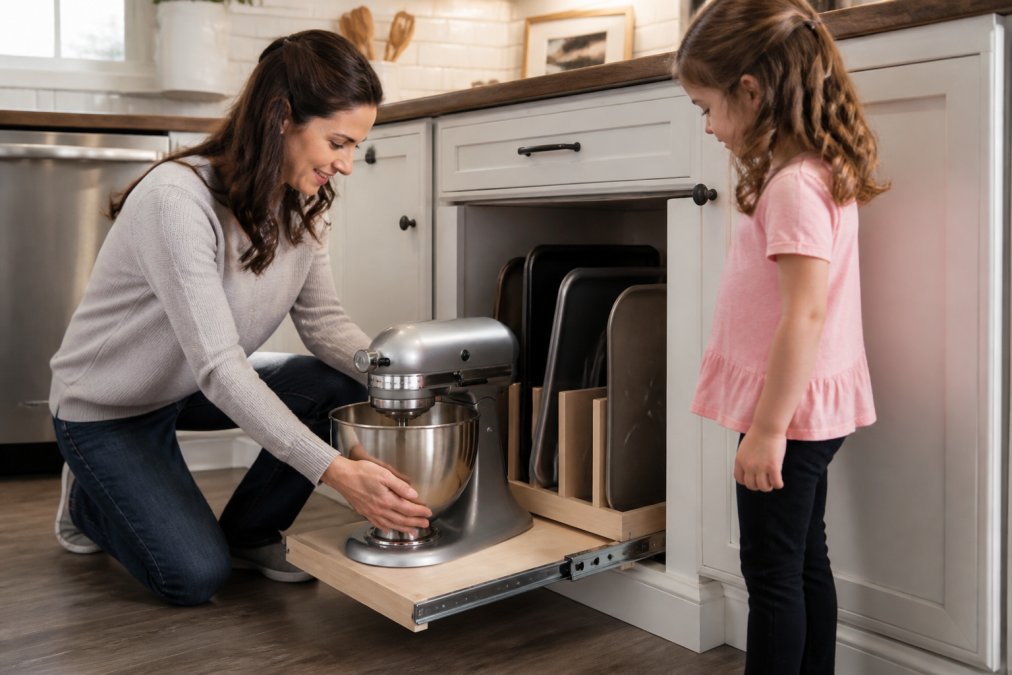
Pull-Out Shelves and Sliding Trays
Pull-out shelving brings deep cabinet contents into view, so you stop excavating the back corner for a blender base. For a family kitchen, the load rating is the spec that matters most, a stand mixer with a bowl and attachments commonly runs 25 to 30 pounds, and a food processor with the work bowl loaded can push past 20 pounds.
Three measurements to take before you buy:
- Interior cabinet depth, a tray even a quarter inch too deep won't slide, and there's no fixing it after installation.
- Cabinet interior width, leave at least a half inch of clearance on each side so the tray doesn't bind when the cabinet box is slightly out of square.
- Door and hinge clearance, a full-extension tray needs the door open past 90 degrees to pull all the way out.
Vertical Dividers and Shelf Risers
Vertical dividers turn a single shelf into a filing system for baking sheets, cutting boards, and trays. The mechanism is simple: instead of stacking flat items into a pile you have to unload to reach the bottom sheet, you stand them on edge and pull one out at a time. Wire dividers adjust to fit; wood or bamboo dividers look better but don't flex, so measure your widest sheet pan first, a standard half-sheet pan is about 18 by 13 inches, and a full-size sheet pan runs closer to 26 by 18 inches.
Cord Management for Stored Appliances
Cords are the detail most storage guides skip, and they're the reason half of family kitchens still look cluttered after organizing. A tangled cord behind a coffee maker makes the appliance annoying to pull out, so it stays on the counter. Fix the cord and the appliance can live in a cabinet.
Three approaches that work:
- Adhesive cord clips mounted on the back inside wall of the cabinet hold the plug end in place so it doesn't fall behind the drawer when you pull the appliance out.
- Velcro cable ties wrap the cord into a compact bundle for storage; leave a few inches of slack at the plug so you're not straining the connection every time you uncoil it.
- A small cable box or cord organizer mounted inside the cabinet keeps the whole bundle contained and out of the way of the appliance itself.
Decluttering Kitchen Counters for Families Without Losing Function
Decluttering kitchen counters for families isn't about emptying them. It's about keeping only what your household touches every single day within arm's reach, and designing the counter so multiple people can use it at once without colliding. That second part is where most guides stop short, and it's the part that actually determines whether a family kitchen stays organized past the first week.
The Counter-Space Minimum
A common pattern among kitchen designers is to leave at least 36 inches of continuous, clear counter for a primary prep zone, and 24 inches for a secondary zone. In a small kitchen, that's the number to protect. If your daily-tier appliances eat into that 36 inches, the household will start prepping on the dining table, and the counter will fill back up with whatever was displaced.
A Workflow That Holds Up in Busy Homes
- Clear everything off the counter and wipe it down.
- Place back only the daily-tier appliances from your earlier sort.
- Group the rest by task: coffee station, prep zone, baking corner.
- Assign each group a nearby cabinet or pull-out shelf.
- Add one storage bin per group for loose parts, cords, and attachments.
- Walk the counter at the busiest time of day, usually before school or before dinner, and check that two people can work without stepping around each other.
Step six is the one most guides skip. A counter that looks tidy at 2 p.m. can still be unusable at 7 a.m. when one person is making coffee and another is packing lunches.
Designing for Multi-Generational Access
In homes with young children or older adults, counter design has to account for reach and grip, not just aesthetics.
- For children: keep the items they use independently, cups, bowls, a toaster, on a lower shelf or a low pull-out they can reach without climbing. A stool next to the counter is safer than a child pulling a heavy appliance down from above.
- For older adults: prioritize mid-height pull-outs for anyone who can't bend or reach overhead. A wall oven or microwave at counter height is easier than one mounted high.
- For everyone: label shelves and bins clearly so each family member can find and return items without asking. A labeled bin for blender attachments prevents the "where does this go?" pile that rebuilds clutter.
What to Keep on the Counter
A minimalist kitchen counter isn't empty; it's intentional. The appliances that earn permanent counter space are the ones used daily by more than one person, or the ones that are too heavy to move comfortably. Everything else belongs in a pull-out, a cabinet, or an appliance garage.
The Best Kitchen Cabinet Organizers for Appliances in High-Traffic Homes
The best kitchen cabinet organizers for appliances solve three problems at once: access, weight, and hidden mess. Families with heavy daily use need organizers built for load, not just looks.
| Organizer Type | Best For | Watch Out For |
|---|---|---|
| Pull-out tray | Stand mixers, food processors | Slider weight rating |
| Appliance garage | Coffee makers, toasters | Ventilation clearance |
| Vertical divider | Baking sheets, trays | Cabinet depth fit |
| Shelf riser | Small gadgets, jars | Door-swing clearance |
| Corner lazy susan | Deep corner cabinets | Weight distribution |
Appliance Garages and Hidden Storage
An appliance garage is a counter-level cabinet with a roll-up or retractable door that hides daily appliances while keeping them plugged in and ready. It's the single most effective way to reduce visible clutter without losing function. Just confirm the garage has enough ventilation clearance so heat from a coffee maker or toaster can escape.
Weight Limits, Cord Management, and Safety for Multi-Generational Homes
Safety and ventilation matter too. Never enclose a heat-producing appliance in a sealed cabinet, and keep a minimum clearance around anything that vents steam or hot air.
Making Small Kitchen Appliances Work in Tight Layouts
Tight layouts reward kitchen layout optimization over sheer storage volume. In a small kitchen footprint, the goal is fewer, better-placed organizing systems rather than more bins.
A few moves that consistently work:
- Mount under-cabinet hooks for mugs and small tools to free shelf space.
- Use over-the-door storage for lightweight items on pantry or cabinet doors.
- Reserve deep cabinet solutions like corner lazy susans for bulky, rarely used pieces.
- Keep a dedicated appliance rotation shelf so seasonal items cycle in and out.
Frequently Asked Questions
How do I arrange small kitchen appliances in a tight kitchen for maximum efficiency?
Group appliances by how often your family uses them. Keep the coffee maker and toaster on the counter or in a pull-out tray at waist height. Store weekly items like a slow cooker on a mid-level shelf. Push occasional appliances such as a waffle iron to high or deep cabinets. This keeps your small kitchen appliances where you actually reach for them and cuts down on bending and digging.
What are the best kitchen cabinet organizers for appliances that hold up to daily family use?
Look for organizers that hold up to the weight of your heaviest appliance, adjustable shelf dividers for baking sheets and trays, and cabinet-height appliance garages. Sturdy metal sliders outlast thin plastic ones in busy households. Measure your cabinet depth and height first, then match the organizer to the appliance you plan to store there.
How can I declutter kitchen counters for families without hiding everything I use daily?
Pick one or two appliances that earn their counter space, usually the coffee maker and toaster, and store the rest. Use a corner lazy susan or a rolling cart for items you use several times a week. Add cord wraps so cables do not tangle. The goal is a clear workspace for meal prep and homework help, not an empty counter you are afraid to use.
How do I keep frequently used appliances accessible but hidden in a small kitchen?
An appliance garage keeps the coffee maker and blender out of sight but within arm's reach. Under-cabinet mounting works for a microwave if the cabinet is rated for the weight. Pull-out drawers at counter height let you slide a mixer forward, use it, and push it back. This approach protects your small kitchen appliances from dust and keeps the countertop ready for cooking.