

Space Saving Furniture vs Custom Built-Ins
Table of Contents
- Space Saving Furniture vs Custom Built-Ins: Quick Comparison
- Pros and Cons of Built-In Cabinetry
- Best Space Saving Furniture for Small Apartments
- Cost of Custom Built-Ins vs Furniture
- Storage Efficiency and Capacity
- Flexibility, Adaptability, and Resale Impact
- Which Option Should You Choose?
- Conclusion
Last Updated: August 24, 2026
Space Saving Furniture vs Custom Built-Ins: Quick Comparison
When you're staring at a cramped studio apartment or a bedroom that's half the size you need, the question isn't academic. You need storage that works, and you need it fast. The choice between space saving furniture and custom built-ins shapes not just how organized your home feels, but how much you'll pay, how long you'll stay committed to the solution, and whether you can take it with you when you move.
This guide breaks down the real trade-offs between these two approaches. Both solve the storage problem, but they solve it in fundamentally different ways, with different costs, different timelines, and different consequences for your home's resale value. Here's what you need to know before you commit.
The comparison isn't straightforward because space saving furniture vs custom built-ins aren't really competing on the same terms. One is flexible and portable. The other is permanent and integrated. Understanding which matters more to your situation is the entire decision.
Pros and Cons of Built-In Cabinetry
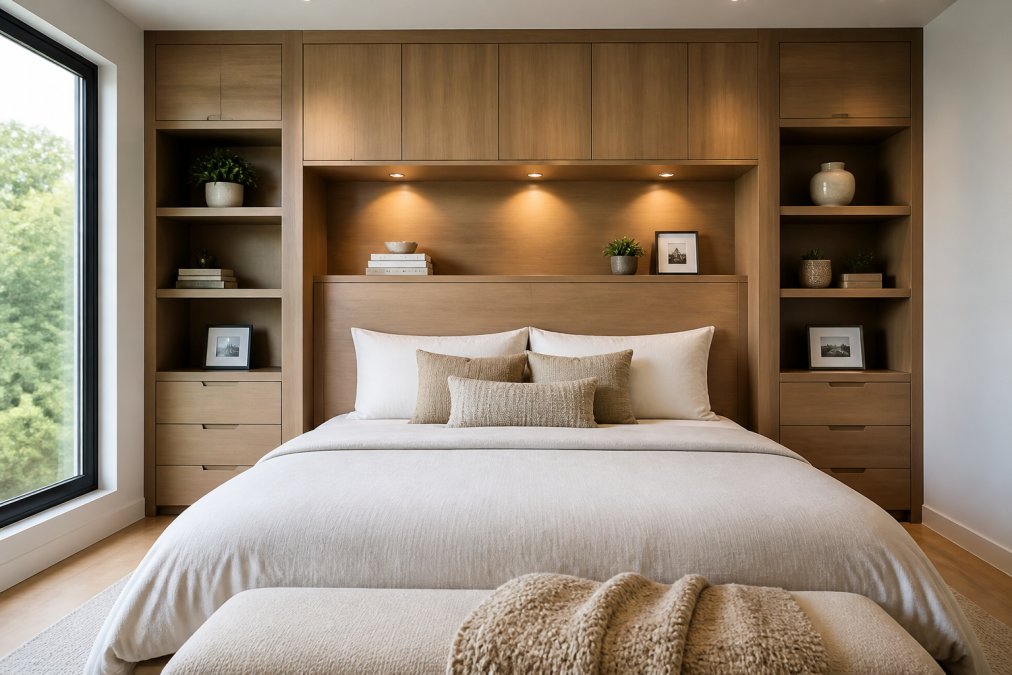
Built-in storage is permanent architectural integration. It's millwork that's designed specifically for your space, fabricated to exact measurements, and installed as a fixture of the home itself. When it works, it's seamless. When it doesn't, you're committed.
Advantages of built-in cabinetry:
Built-ins maximize every inch of available space. A custom closet system or wall-to-wall shelving uses vertical and horizontal space that freestanding furniture can't reach. You're not losing floor area to the footprint of a cabinet, the storage IS the wall.
The aesthetic integration is unmatched. Built-ins create a cohesive, finished look that freestanding furniture simply cannot replicate. This architectural integration signals intentional design rather than "stuff we had to fit in."
Storage capacity per square foot is dramatically higher. Custom cabinetry lets you optimize drawer depth, shelf spacing, and compartmentalization for your specific items. A custom closet system with built-in shelving, hanging rods, and drawers holds roughly 40-50% more than the same wall space filled with freestanding furniture (peer-reviewed research).
Home resale value increases when built-ins are well-executed. Buyers perceive custom storage as a premium feature. A thoughtfully designed home office with built-in shelving and desk integration, or a master closet with custom millwork, genuinely moves the needle on perceived home value.
Disadvantages of built-in cabinetry:
The cost is substantial. Custom built-in storage typically ranges from $1,000 on the low end to $11,000 or more depending on scope, materials, and complexity (bls.gov). That's a real financial commitment with no portability. If you move, it stays.
Installation timelines are longer. From design consultation through fabrication to installation, custom built-ins typically take 4-8 weeks (nkba.org). You're not living with your new storage solution next week.
Modification and repair are expensive. If your needs change, you can't simply move a shelf or swap a cabinet. Reconfiguring built-ins means calling the installer back, which costs money and time. Repairs require professional carpenters, not a trip to a hardware store.
Rental situations are off-limits. If you rent, custom built-ins are a non-starter. Landlords won't allow permanent modifications, and even if they would, you'd lose your investment when you move.
Flexibility is zero. Built-ins lock you into a specific layout and organizational system. If your life changes, if you need different storage types, if your family size shifts, if your work-from-home setup evolves, you're stuck with what you built.
Best Space Saving Furniture for Small Apartments
For renters, frequent movers, and anyone who values flexibility, space saving furniture delivers practical solutions without the permanent commitment. These pieces are designed around the constraint of small spaces, and they prioritize versatility.
Murphy Door Wall Beds ($1,290 starting price) are handcrafted wall beds built from real wood veneer with a lifetime warranty on hardware and workmanship. Unlike thin sofa-style alternatives, these accept standard mattresses, so you get a real bed experience that folds away into the wall. They're available in vertical, horizontal, media console, and desk bed configurations. The engineering is solid, these aren't flimsy mechanisms. Setup requires assembly, and the initial cost is steep, but for someone who needs a full-size bed that disappears during the day, this solves a real problem.
The Expand Furniture Transforming Table 4 ($548) converts from a coffee table to a full-size dining table through a hydraulic lift mechanism. The tabletop doubles in size when you fold it open, and it adjusts from 8 inches to 30 inches in height. It comes fully assembled with hidden wheels for easy repositioning. This is pure versatility, one piece handles coffee table, dining table, and workspace functions. The trade-off is that it won't accommodate a large dinner party, and the available finishes are limited compared to custom options.
The UNFNSHED Modular Shelf ($139 starting price for two shelves) is a sustainably sourced Baltic birch plywood system with tool-free assembly and interlocking joinery. You can expand it in any direction, stacking units horizontally or vertically as your needs change. This is the most affordable option and the most adaptable. The aesthetic is limited to natural plywood, which works in some design schemes and clashes in others. But if you need flexible, reconfigurable shelving that you can take with you when you move, this delivers.
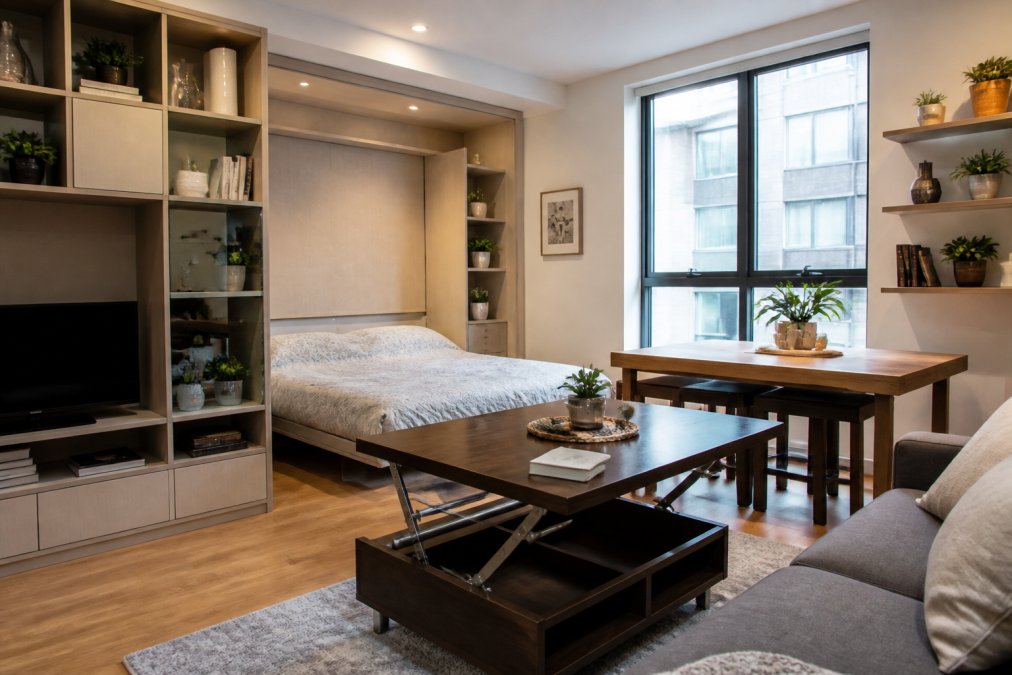
These pieces share a common advantage: portability. When you move, they move with you. Your investment isn't locked into a specific property.
Cost of Custom Built-Ins vs Furniture
The financial math is straightforward but worth spelling out clearly.
Custom built-ins start around $1,000 for a basic closet system and climb to $11,000 or more for whole-room solutions with premium materials and finishes. California Closets, a leading provider, typically charges project-based pricing in the $1,000-$11,000 range depending on scope. This includes design consultation, materials, fabrication, and professional installation.
Space saving furniture ranges from $139 for a basic modular shelf to $1,290 for a high-quality wall bed. Most pieces fall between $400-$800. You're buying individual units, not a comprehensive room solution, so the total investment depends on how many pieces you need.
The real cost difference emerges when you factor in portability and permanence. If you live in your home for 10+ years, the per-year cost of built-ins decreases significantly. If you move every 3-5 years, that same built-in investment is sunk, it stays with the property, and you start over in your next home.
For renters, the comparison isn't even close. Built-ins are impossible. Your only option is furniture, which means the cost question becomes "which furniture pieces solve my problem most efficiently."
For homeowners planning to stay long-term, built-ins offer better storage density per square foot and genuine aesthetic integration. But that premium comes with a premium price and zero flexibility.
Storage Efficiency and Capacity
This is where built-ins genuinely outperform freestanding furniture.
Custom built-in cabinetry uses vertical space from floor to ceiling and horizontal space wall-to-wall. There's no wasted perimeter space, no gaps between furniture and walls, no dead zones above standard-height cabinets. A 10-by-12-foot bedroom wall covered entirely with custom shelving and cabinetry can store roughly 40-50% more than the same wall space filled with freestanding dressers, shelves, and storage boxes.
Space saving furniture is inherently limited by its footprint. A modular shelf system is efficient for what it is, but it occupies floor space. A wall bed reclaims daytime floor area, but it doesn't store more than a traditional closet would, it just hides the bed. A transforming table saves space by serving multiple functions, but it's not adding storage capacity; it's reducing the number of pieces you need.
The practical implication: if raw storage capacity is your priority, built-ins win decisively. If you need flexibility and portability, space saving furniture is the trade-off you accept.
For small apartments where every square foot matters, this efficiency gap is the strongest argument for custom built-ins. But it only makes sense if you're staying long enough to justify the cost and commitment.
Flexibility, Adaptability, and Resale Impact
This is where the two approaches diverge most sharply.
Flexibility: Freestanding space saving furniture is infinitely flexible. You can rearrange, reconfigure, replace, or remove pieces as your needs change. A modular shelf system can expand or contract. A transforming table can be swapped out for a different design. A wall bed can be removed if you decide you need the wall space for something else.
Built-ins are the opposite. They're fixed. If your organizational needs change, if you need different storage types, if your family situation shifts, you're working within the constraints of what you built. Modification is possible but expensive and disruptive.
Adaptability to room changes: Space saving furniture adapts to your room. Built-ins require your room to adapt to them. If you're renting or planning to move, this distinction is critical. If you own your home long-term, it's less relevant.
Resale impact: This is the hidden advantage of custom built-ins. Buyers perceive high-quality built-in storage as a premium feature. A master bedroom with custom closet millwork, a home office with built-in shelving and desk integration, or a kitchen with custom cabinetry genuinely influences perceived home value and buyer interest.
Freestanding furniture has zero resale impact. When you sell, your furniture moves with you. The buyer sees an empty room, not the organizational system you created.
For homeowners planning to stay 7+ years, this resale premium can offset a significant portion of the built-in investment. For anyone else, it's irrelevant.
Which Option Should You Choose?
The decision hinges on three questions: Are you renting or owning? How long are you staying? How much storage do you actually need?
Choose space saving furniture if:
You're renting. Built-ins are impossible, and your landlord won't allow permanent modifications. Furniture is your only option.
You move every 3-5 years. The investment in built-ins doesn't have time to pay off, and you'll lose it when you sell or move.
You value flexibility. Your life, family size, or work situation might change. Furniture adapts; built-ins don't.
You're budget-constrained. Furniture costs a fraction of built-ins. A $700-$1,000 investment in modular shelving and a transforming table solves most small-space problems without breaking the bank.
You have a specific organizational need but aren't sure it's permanent. Test the solution with furniture first. If it works, you can always upgrade to built-ins later.
Choose custom built-ins if:
You own your home and plan to stay 7+ years. The per-year cost decreases, and the resale premium becomes meaningful.
You need maximum storage density in a small space. Built-ins use every inch more efficiently than furniture can.
You want architectural integration and a finished, designed look. Built-ins create seamless aesthetic cohesion that freestanding pieces can't match.
You're willing to invest upfront for a permanent solution. The higher cost is worth it if you're committed to the space long-term.
Your home layout has awkward angles, alcoves, or irregular dimensions. Custom built-ins are designed for your specific space; furniture works with standard rectangular footprints.
The hybrid approach is worth considering too. Many homeowners start with space saving furniture, test what works, and then invest in built-ins for permanent solutions once they've figured out their actual needs. This reduces the risk of building custom storage that doesn't solve your real problem.
Maximizing a small space requires honest assessment of your situation, not aspirational thinking about what you should want. At Viva homeStore, we help families and individuals find practical solutions that actually fit their lives, whether that's flexible, portable furniture or the commitment of custom integration. The right choice depends on your timeline, your budget, and whether you're building a permanent home or a temporary solution. Shop now to explore space saving furniture options that adapt to your needs, or consult a professional about custom built-ins if you're ready for a permanent investment in your space.
Frequently Asked Questions
Are custom built-ins worth the investment for small homes?
Custom built-ins maximize every inch of wall space and create a seamless, integrated look that enhances perceived room size. However, they require significant upfront investment and are permanent fixtures. Space saving furniture offers flexibility at a lower cost, making it ideal for renters or those wanting to change layouts. The choice depends on whether you prioritize permanence and aesthetic cohesion or adaptability and budget constraints.
Is it cheaper to install custom cabinets or buy high-end space-saving furniture?
Space saving furniture typically costs less upfront, with modular shelving starting around $139 and transforming tables at $548. Custom built-ins range from $1,000 to $11,000 or more, depending on complexity and materials. However, custom built-ins may add resale value, while furniture depreciates. For budget-conscious buyers, space saving furniture provides immediate affordability; for long-term homeowners, built-ins can be a worthwhile investment.
Can space-saving furniture provide the same storage capacity as built-ins?
Space saving furniture can match or exceed built-in storage capacity when strategically combined. Modular shelving systems expand vertically and horizontally, and transforming tables serve multiple functions. However, custom built-ins are optimized for your exact space and often utilize awkward corners and wall heights more efficiently. The difference lies in customization: furniture offers versatility, while built-ins offer maximum utilization of your specific room dimensions.
How do built-ins affect the perceived size of a room?
Well-designed built-ins can make rooms feel larger by eliminating visual clutter and creating architectural integration. Floor-to-ceiling cabinetry draws the eye upward, enhancing perceived height. Wall-to-wall storage eliminates gaps that make spaces feel disorganized. Space saving furniture, when arranged thoughtfully, also reduces clutter but doesn't create the same seamless, expansive effect. Built-ins offer superior aesthetic cohesion, while furniture provides flexibility if you want to change your room's visual flow.
What are the main disadvantages of custom built-ins?
Custom built-ins are permanent, making them unsuitable for renters or those who relocate frequently. They require significant upfront investment and have longer lead times for design and installation. If your space needs change, you're stuck with fixtures designed for previous layouts. Maintenance and repairs can be costly and complex. Space saving furniture avoids these drawbacks, offering portability and lower commitment, though it sacrifices the integrated aesthetic and optimized storage efficiency that built-ins provide.
This article was written using GrandRanker