

Benefits of Minimalist Home Decor for Small Spaces
Table of Contents
- Why Minimalist Home Decor Works in Small Spaces
- How to Organize a Small Studio Apartment with Minimalist Principles
- Space-Saving Furniture Ideas That Do Double Duty
- Decluttering Small Living Spaces: A Room-by-Room Approach
- Lighting and Maintenance Routines for a Minimalist Home
- How Minimalist Home Decor Saves Money and Reduces Visual Stress
- Conclusion
- Frequently Asked Questions
Last Updated: September 16, 2026
Why Minimalist Home Decor Works in Small Spaces
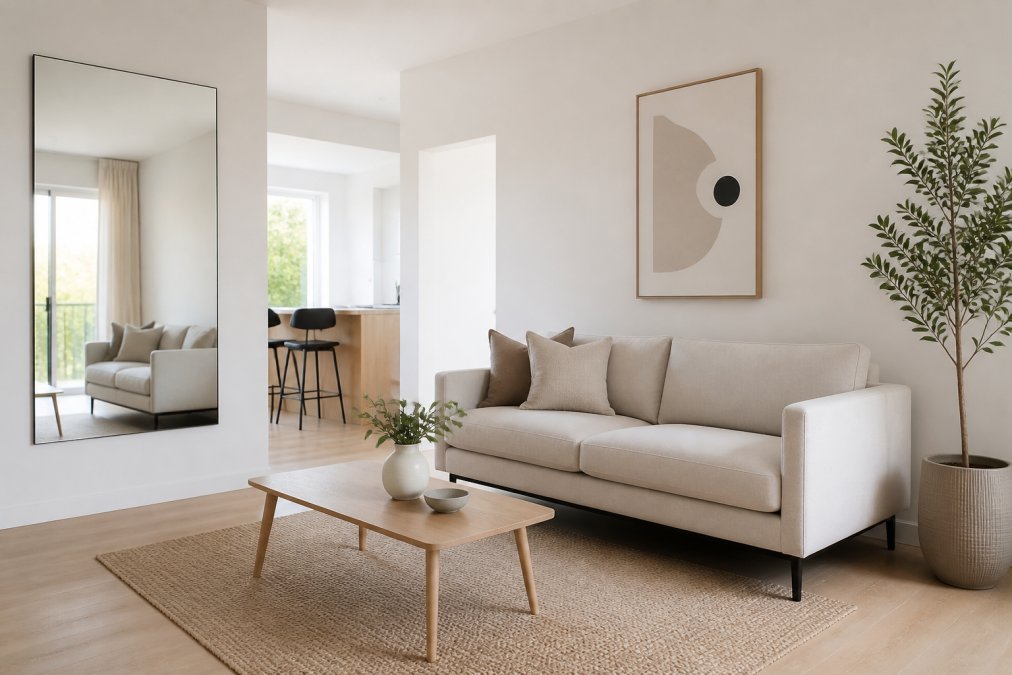
Minimalist home decor is a design approach that removes non-essential objects and furniture to make a room feel larger, calmer, and easier to live in. For small apartments, that means fewer pieces, lighter colors, and furniture that earns its footprint.
The mechanics are simple. Every object in a small room competes for the same limited sightline, so visual clutter reads as physical crowding. Remove the excess and the eye has room to travel, which is why the benefits of minimalist home decor for small spaces show up before you buy a single new item.
The Psychology of Empty Space
Empty space is not wasted space. Research on crowding consistently links cluttered, visually busy rooms with higher stress and poorer focus, while open, orderly rooms support a calmer, more restorative mood (American Psychological Association research on environment and stress). In a small home, that effect is magnified because you cannot leave the room to escape the mess.
How to Organize a Small Studio Apartment with Minimalist Principles
Organizing a small studio apartment starts with zoning, not shopping. Divide the single room into clear functional zones, then let each zone hold only what it needs. A common mistake is treating a studio as one big room and letting every object float between functions.
A practical sequence that works:
- Define zones first. Sleeping, working, eating, and relaxing each get a defined area, even if it is just a rug and a lamp.
- Assign storage by zone. Items live where they are used, not in a distant closet.
- Go vertical. Wall-mounted shelves and hooks keep the floor open and the room feeling larger.
- Cap your surfaces. If a countertop or shelf is full, something has to leave.
- Reassess monthly. Studios drift back toward clutter faster than larger homes.
For a deeper walkthrough of studio-specific layouts, see our guide on [how to organize a small studio apartment(/blogs/news/how-to-organize-small-studio-apartment) | vivahomestore.net].
Space-Saving Furniture Ideas That Do Double Duty
Space-saving furniture ideas work best when each piece replaces two. A storage ottoman that also seats a guest, a wall-mounted desk that folds away, and floating shelves that hold books and display objects all remove furniture from the floor without removing function.
| Furniture Piece | Primary Function | Second Function | Best For |
|---|---|---|---|
| Storage ottoman | Seating | Hidden storage | Studio apartments |
| Wall-mounted desk | Workspace | Folds flat when idle | Home offices |
| Floating shelves | Display | Vertical storage | Small rooms |
| Large mirror | Decor | Doubles perceived space | Dark or narrow rooms |
Multifunctional Furniture Integration
Multifunctional furniture integration is the practice of choosing pieces that serve at least two purposes so the total number of objects drops. The trade-off is real: a dual-purpose piece usually does neither job quite as well as two dedicated items. In a small space, that compromise is almost always worth it.
At Viva homeStore, our floating wall shelves and compact storage pieces are built around this idea: use the wall, free the floor, and keep the visual field calm. If you already own bulky furniture, replace one piece at a time rather than overhauling everything at once.
Decluttering Small Living Spaces: A Room-by-Room Approach
Decluttering small living spaces is easier when you work one room at a time and set a hard limit for each category. Blanket "declutter everything" plans fail because they have no finish line.
- Living room: one piece of wall art, one plant, one basket for remotes and cables.
- Bedroom: under-bed storage only for items used seasonally; nothing else lives under the bed.
- Kitchen: keep only tools you used in the last month on the counter; the rest goes in a drawer or leaves.
- Bathroom: one product per function, no duplicate bottles.
Lighting and Maintenance Routines for a Minimalist Home
Lighting and maintenance are the two parts of minimalist design most people skip, and they are the two that keep a small space feeling open. Good light makes a room read as larger; a simple maintenance routine keeps it that way. This is the section most small-space guides rush, here is the actionable version.
Ambient Lighting Design for Small Spaces
Ambient lighting design for small spaces means layering light instead of relying on one overhead fixture, and choosing the right color temperature for each layer. A single bright ceiling light flattens a room and makes corners feel closed in. Three layers fix that:
- Ambient layer. A ceiling or large floor source that fills the room. Aim for a warm-to-neutral white (roughly 2700K-3000K) rather than a cool daylight bulb, which tends to make small rooms feel clinical.
- Task layer. A focused lamp over the desk, reading chair, or kitchen counter. This is where you can go slightly brighter and cooler so you can actually see your work.
- Accent layer. A small uplight or picture light that washes a wall. Wall-washing is the cheapest trick for making a low ceiling feel taller, because the eye reads the lit wall as depth.
Placement matters as much as the bulbs. Put light in the corners you want to feel open, not just the center of the room. A floor lamp tucked into a dark corner visually pushes that corner back, which expands the perceived footprint. Pair this with light-toned walls and a large mirror opposite your brightest window, and the room reads larger before you move a single piece of furniture.
A Minimalist Maintenance Checklist for Small Homes
Minimalism is not a one-time declutter; it is a cadence. Small homes drift back toward clutter faster than large ones because there is less buffer space, so the routine has to be short enough that you actually do it. This checklist is built to take minutes, not hours:
- Daily (5 min): Wipe surfaces, clear counters, and return misplaced items to their zone before bed.
- Weekly (15 min): Dust shelves and light fixtures, vacuum under furniture edges, and reset one "drop zone" (entry table, kitchen counter).
- Monthly (30 min): Review one drawer or shelf and remove anything you have not used. One drawer a month clears twelve a year.
- Seasonally (1 hr): Rotate or remove items tied to a season, coats, fans, holiday decor, so off-season items leave the visible field entirely.
- Annually: Reassess furniture. If a piece has not earned its footprint in a year, it is a candidate to replace with something that does double duty.
How Minimalist Home Decor Saves Money and Reduces Visual Stress
Minimalist home decor saves money because it changes what you buy, not just how much. When every purchase has to earn its place, you stop buying duplicates, trend pieces, and decor you will tire of in a season. That is the quiet financial case for minimalism, and it is stronger than most people expect.
The health case runs alongside it. A clutter-free, well-lit room is easier to clean, easier to rest in, and easier to maintain, which is why minimalist principles tend to stick once people try them.
Conclusion
The real challenge with small-space living is not square footage, it is the constant pressure to add. Minimalist home decor gives you a filter for that pressure, and the result is a home that feels larger, calmer, and easier to keep. Viva homeStore carries the practical pieces that make this work: floating wall shelves that use vertical space, compact storage furniture that hides what you actually need, and lighting that opens up a room.
Frequently Asked Questions
What exactly is multifunctional furniture?
Multifunctional furniture serves more than one purpose in a single piece. Examples include a storage ottoman that acts as seating and hides blankets, a wall-mounted desk that folds away when not in use, or a sofa bed for guests. For small spaces, these pieces reduce the number of items you need, which cuts visual clutter and frees up square footage. When choosing, look for sturdy construction and a design that matches your existing neutral color palette.
How does minimalist decor make a small room look bigger?
Minimalist decor reduces visual clutter, which makes a room feel more spacious. By limiting decor embellishments and using a neutral color palette, your eye travels further without stopping on busy patterns or piles of objects. Large mirrors and ambient lighting also help by reflecting light and creating depth. The result is a calm, open feel that maximizes the perception of square footage without any structural changes.
Is minimalist design practical for small apartments?
Yes. Minimalist design is highly practical for small apartments because it prioritizes function and spatial efficiency. Space-saving furniture ideas like floating shelves, wall-mounted desks, and storage ottomans keep floor areas open. Decluttering small living spaces becomes easier when every item has a purpose. You also save time on cleaning and maintenance. The key is to focus on quality over quantity and choose pieces that serve multiple needs.
What are the psychological benefits of living in a minimalist home?
A minimalist home can reduce visual stress and promote a sense of calm. With less clutter, your brain processes fewer visual stimuli, which may help lower feelings of anxiety. Many people report improved focus and a greater sense of control over their environment. Intentional living, where you choose only what you need, supports psychological well-being by aligning your space with your priorities. The empty space itself becomes a source of relaxation rather than something to fill.