

Best Kitchen Cabinet Organizers for Small Kitchens 2026
Table of Contents
- Quick Comparison: Top Cabinet Organizers for Small Kitchens
- Pull-Out Cabinet Organizers: Best for Deep Base Cabinets
- Under-Sink Storage Solutions That Work Around Plumbing
- Small Kitchen Organization Hacks for Every Cabinet Type
- Weight Capacity and Installation Safety: What to Check Before You Buy
- Rental-Friendly and Aging-in-Place Organizer Options
- How to Maintain and Clean Your Cabinet Organizers
- Conclusion
- Frequently Asked Questions
Last Updated: September 20, 2026
Quick Comparison: Top Cabinet Organizers for Small Kitchens
The best kitchen cabinet organizers for small kitchens turn wasted depth, height, and door space into usable storage. This guide compares pull-out systems, expandable risers, turntables, and bins so you can match each organizer to your actual cabinet footprint.
Small kitchens rarely fail because of a lack of cabinets. They fail because the space inside those cabinets goes unused. A deep base cabinet swallows pots you never see again. A narrow gap beside the fridge holds nothing but dust. A common mistake is buying storage before measuring the cabinet, then discovering the riser is 2 inches too wide or the pull-out hits the door hinge.
| Organizer | Best For | Key Feature | Watch Out For |
|---|---|---|---|
| Pull-out shelf (Rev-A-Shelf) | Deep base cabinets | Full-extension slides | Needs tools to install |
| Expandable riser (Yamazaki Home) | Plates and bowls | Adjusts 10¾-17¾ in wide | Costs more than plastic |
| Lazy susan (mDesign) | Corner cabinets | 360-degree rotation | Leaves gaps in square corners |
| Clear bins (Vtopmart) | Pantry clutter | Stackable, see-through | Plastic can crack if overloaded |
| Door rack (Rubbermaid) | Dead door space | Over-door or screw mount | Can block shelf items |
| Drawer insert (Pipishell) | Flatware drawers | Expandable bamboo | Measure drawer first |
| Roll-out spice rack (Lynk) | Narrow gaps | Ball-bearing glides | Fits only certain jars |
| Shelf riser (Simple Houseware) | Canned goods | Stacks to double capacity | Looks messy if overloaded |
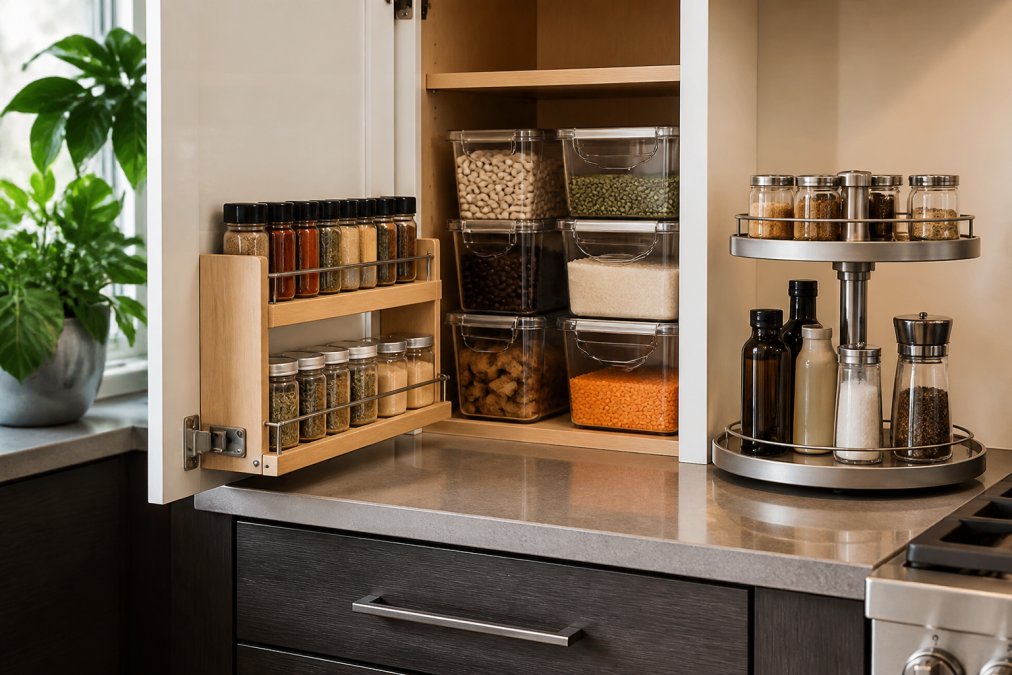
Pull-Out Cabinet Organizers: Best for Deep Base Cabinets
Pull-out cabinet organizers are sliding shelves that mount to the cabinet floor and bring back-of-cabinet items within reach. The Rev-A-Shelf Pull-Out Cabinet Organizer is the benchmark here, with full-extension ball-bearing slides and heavy-duty chrome or wood construction.
What most guides miss is that deep base cabinets are the single biggest source of wasted space in a small kitchen. You stack items two rows deep, then forget the back row exists. A pull-out solves that by converting depth into a single accessible layer.
The trade-off is installation. Rev-A-Shelf units mount directly to the cabinet floor and typically require a drill and a screwdriver. If you rent, that matters. Budget roughly an hour for a first install.
- Best for: Pots, pans, and small appliances in cabinets deeper than 20 inches
- Pros: High weight capacity, genuinely improves accessibility
- Cons: Requires tools, and the price sits at the top of this list
Under-Sink Storage Solutions That Work Around Plumbing
Under-sink storage is the hardest cabinet in a small kitchen to organize because the space is not a box, it is a box with a P-trap, a garbage disposal, a shutoff valve, and often a dishwasher supply line cutting through it. The organizers that work are the ones designed around that geometry, not the ones that look best in a photo.
Start by mapping the actual clearance. In a standard 36-inch base cabinet, the disposal typically hangs 12 to 14 inches below the counter on one side, the P-trap drops 8 to 10 inches in the center, and the shutoff valves sit 4 to 6 inches off the back wall. That leaves two usable zones: a tall column on the side opposite the disposal, and a low, wide tray zone in front of the P-trap. Most off-the-shelf "under-sink" bins are sized for the front zone only.
What actually fits:
- Two-bin split (front zone): A pair of shallow open-top bins, roughly 12 by 9 by 6 inches, slides in front of the P-trap and lifts out for cleaning. The InterDesign Plastic Organizer Bin is the common pick here, BPA-free, built-in handles, and shallow enough to clear the trap. Two bins beat one large bin because you can pull one out without unloading the other.
- Side column (disposal side): A narrow, tall bin or a two-tier riser fits the vertical gap beside the disposal. Look for a footprint under 10 inches wide. This is where tall spray bottles and dishwasher pods belong.
- Door space: The Rubbermaid Cabinet Door Organizer mounts over the door or screws in. Measure the tallest item on the shelf behind it first, a door rack that collides with a spray bottle is worse than no rack. Over-door versions carry light loads only; screw-mounted versions hold more but require drilling.
- Lazy susan (corner under-sink): If the sink sits in a corner cabinet, a turntable in the deep corner recovers space a bin cannot reach. The mDesign Lazy Susan Turntable rotates 360 degrees and needs no hardware.
Materials and cleaning matter more here than anywhere else. Under-sink cabinets see humidity swings, small leaks, and occasional drips. Plastic bins wipe clean with warm soapy water and dry fast. Bamboo and unsealed wood warp and grow odor in that environment, avoid them under the sink. Metal racks are fine if the coating is intact; bare or chipped metal will rust.
A common pattern: people buy one large bin, discover the disposal blocks half of it, and give up. Two or three smaller bins that fill the gaps on either side of the pipes, plus one door rack, solve the cabinet without any custom work.
U.S. Consumer Product Safety Commission guidance on safe storage of household chemicals
Small Kitchen Organization Hacks for Every Cabinet Type
Most guides list the same five moves, riser, turntable, spice rack, drawer insert, bins, and stop there. The gap none of them close is which organizer fits which cabinet geometry, and why. That is the part that decides whether a purchase works or ends up in a donation box. Here is the same five-cabinet map, but with the measurements and mechanisms that actually determine fit.
Upper cabinets (12 inches deep, 30 to 36 inches tall): The usable gain is vertical, not horizontal. A stackable shelf riser doubles the surface for mugs, glasses, and small bowls.
U.S. Consumer Product Safety Commission guidance on furniture and shelf tip-over safety
Weight Capacity and Installation Safety: What to Check Before You Buy
Check three things before buying:
- Rated load. Pull-out systems list a capacity; cheap risers often do not. Assume a plastic bin holds less than it looks like it should.
- Mounting method. Screw-mounted organizers hold more weight than tension-mounted or adhesive options. Adhesive hooks suit light items only.
- Cabinet construction. Particleboard shelves can strip under repeated load. Solid wood and plywood handle screws far better.
For renters, tension-mounted and over-the-door options avoid drilling entirely, though they carry lower limits.
Rental-Friendly and Aging-in-Place Organizer Options
Rental-friendly organizers avoid permanent changes, and aging-in-place options reduce reaching and bending. Both needs point to the same solutions: pull-outs, turntables, and door racks.
How to Maintain and Clean Your Cabinet Organizers
Maintenance keeps organizers working and extends their life. Most failures trace back to overload or neglect, not manufacturing.
A simple routine:
- Monthly: Wipe plastic bins with warm soapy water and dry fully before refilling.
- Quarterly: Vacuum crumbs from drawer inserts and pull-out tracks.
- Twice a year: Tighten screws on mounted racks and check slides for grit.
- As needed: Wipe steel risers with a damp cloth; avoid abrasive pads that scratch the coating.
Conclusion
The hardest part of organizing a small kitchen is matching the organizer to the cabinet you actually have, not the one in the photo. Measure depth, width, and plumbing clearance first, then buy.
USDA FoodSafety.gov guidance on food storage and food-grade containers
Frequently Asked Questions
What is the best cabinet organizer for a small kitchen with deep cabinets?
Pull-out cabinet organizers with full-extension ball-bearing slides work best for deep base cabinets. They let you reach items in the back without kneeling or unloading the front. Look for heavy-duty steel or wood construction rated for at least 50 pounds if you store appliances or canned goods. Measure your cabinet interior width and depth first, since pull-out units need a few inches of clearance to slide freely.
How do I organize under-sink cabinets around plumbing?
Use a tension-mounted or freestanding two-tier organizer that wraps around the drain pipe, or try open-top plastic bins that fit on either side of the plumbing. Avoid adhesive hooks on the cabinet floor near pipes, since heat and moisture weaken the bond. Measure the clearance between the pipe and cabinet wall before buying. Stackable bins let you use the vertical space above the disposal without blocking access.
Are there rental-friendly cabinet organizers that do not require drilling?
Yes. Tension-mounted shelf risers, over-the-door racks, adhesive hooks rated for the surface, and freestanding stackable bins all work without permanent installation. Magnetic storage strips also attach to steel cabinet doors without screws. These options are ideal if you cannot modify cabinets or want to avoid patching holes when you move out. Check the weight limit on adhesive products, since most hold 5 to 10 pounds.
How do I keep cabinet organizers from cracking or warping over time?
Wipe plastic bins with warm soapy water and dry them completely before restacking. Bamboo and wood organizers should be wiped with a damp cloth and treated with food-safe mineral oil every few months to prevent drying and cracking. Avoid overloading plastic bins past their rated capacity, since stress cracks start at the corners. For metal racks, check screws and mounting brackets every six months and tighten as needed.