

Spice Rack Organization Ideas for Family Cooking
Table of Contents
- Countertop Spice Racks That Keep Family Favorites Within Reach
- Best Spice Storage Containers for Families
- Drawer Spice Inserts and Stackable Tins for Clutter-Free Kitchens
- Organizing Spices by Frequency of Use for Faster Cooking
- How to Label Spice Jars for Easy Identification
- Wall-Mounted and Cabinet Door Spice Storage for Small Kitchens
- Budget-Friendly Upcycling and Climate-Controlled Storage Tips
- Frequently Asked Questions
Last Updated: September 24, 2026
Countertop Spice Racks That Keep Family Favorites Within Reach
Spice rack organization ideas for family cooking start with one hard truth: the spices you reach for daily should never live behind a closed door. This guide from Viva homeStore covers the layouts that survive a busy household.
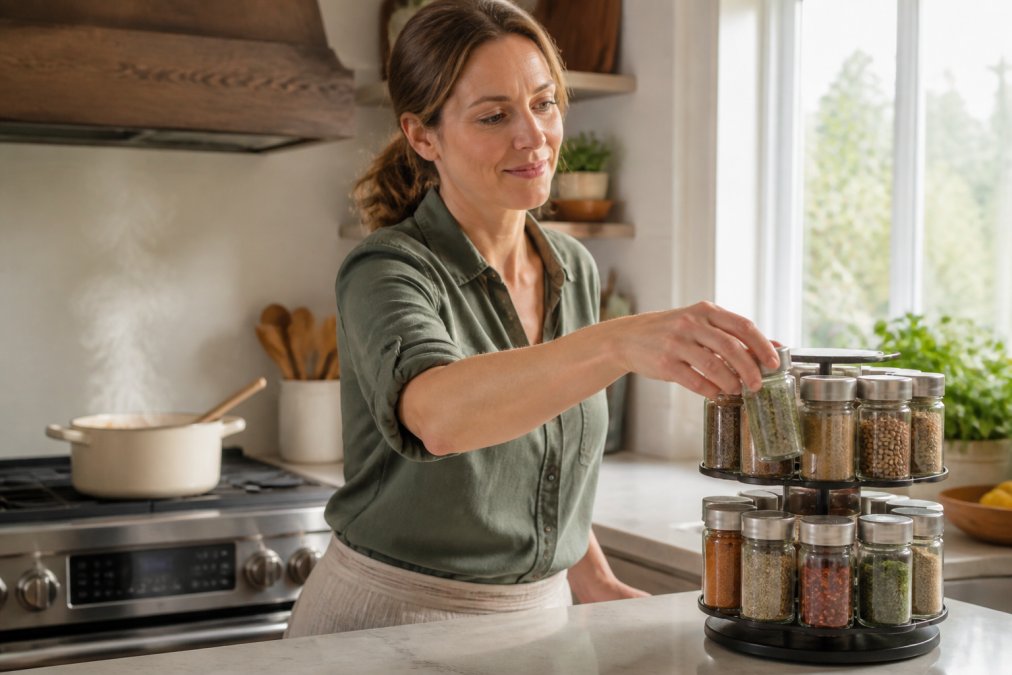
Tiered Racks and Lazy Susans for Busy Cooks
A tiered rack gives every jar its own step, so labels stay readable without lifting anything. A lazy susan solves the opposite problem: deep corners where jars disappear.
Best Spice Storage Containers for Families
The best spice storage containers for families are airtight, uniform, and sized to how you actually buy spices. Mismatched jars waste vertical space, hide labels, and force constant reshuffling.
Match the Container to the Buying Habit
- Ball Mason Jar Spice Storage Set: 4-ounce glass jars with two-piece airtight lids. Best for bulk buyers who portion into daily-use jars and keep the rest sealed. Glass does not absorb odors the way plastic does, which matters with cumin, smoked paprika, and curry blends.
- Talented Kitchen Magnetic Spice Tins: Clear lids, magnetic backing, pre-printed labels included. Best for zero-counter kitchens where the side of the refrigerator or a steel backsplash is the only vertical surface left.
- YouCopia SpiceStack: Stackable drawers that pull out and drop down for visibility. Best for deep cabinets where back-row jars would otherwise disappear.
- OXO Good Grips Pop Containers: Push-button seal with a gasket that compresses when you press the top. Best for families who want one-handed opening while the other hand is holding a spoon.
- Rubbermaid Brilliance 4-Ounce Containers: Clear Tritan plastic with a locking lid. Best for wall-mounted racks where weight matters and glass is a liability.
Glass vs. Plastic: The Real Trade-Off
Glass protects flavor better over time and does not hold onto odors from strong spices. It is also heavier, a problem on a wall-mounted rack, and it can chip at the rim if knocked against a cast-iron pan.
| Container Type | Best For | Key Trade-Off |
|---|---|---|
| Glass mason jars | Bulk buyers, long storage | Heavier, needs manual labeling |
| Magnetic tins | Zero-counter kitchens | Requires a magnetic surface |
| Stackable drawer systems | Deep cabinets | Plastic feel, less premium |
| Pre-filled rotating racks | Ready-to-use setups | Fixed jar sizes |
| Push-button sealed containers | One-handed cooking | Gasket needs periodic cleaning |
The Refill Workflow Most Guides Skip
Here is the part almost no container roundup covers: how you move spice from the bulk bag to the jar you cook from. The pattern that works is a two-tier system.
- The working jar sits on the counter, in the drawer, or on the rack. It holds about four ounces, roughly a month of cooking for a family that uses that spice weekly.
- The reserve bag stays sealed in a cool, dark cabinet, ideally in a container that blocks light. You open it only when the working jar runs low.
Airtight Is Not a Marketing Word
A lid that clicks is not necessarily a lid that seals. The mechanism that matters is a gasket, a rubber or silicone ring that compresses against the rim. Push-button containers and two-piece mason lids both use one; a screw-top jar with no gasket lets in humid air every time the kitchen steams up.
Drawer Spice Inserts and Stackable Tins for Clutter-Free Kitchens
Drawer inserts hide your spices from heat and light, where most countertop setups fall short. The Lynk Professional Expandable Drawer Spice Organizer uses heavy-gauge steel and adjusts to different drawer widths without tools.
Organizing Spices by Frequency of Use for Faster Cooking
Organizing spices by frequency of use means the five or six seasonings you touch every week get the closest, easiest spot, and everything else moves outward. This single change speeds up cooking more than any product purchase.
Sort your collection into three tiers:
- Daily: salt, pepper, garlic powder, onion powder, paprika, cumin
- Weekly: oregano, chili powder, cinnamon, bay leaves, Italian seasoning
- Occasional: nutmeg, cardamom, saffron, specialty blends
How to Label Spice Jars for Easy Identification
Labeling spice jars for easy identification comes down to three rules: label the lid, label the side, and use the same font size everywhere. When every jar matches, your eye scans instead of reads.
- Label the lid so you can identify jars from above in a drawer
- Label the side at a consistent height for shelf and rack viewing
- Include the purchase date on bulk jars so you know what to replace
- Skip handwritten tape on glass; it peels and looks messy within weeks
Wall-Mounted and Cabinet Door Spice Storage for Small Kitchens
Wall-mounted and cabinet door storage turns dead space into usable storage, which matters most in small kitchens. But the real design question is not where the rack goes, it is who has to reach it, and how far.
The Reach Zone That Decides Everything
Ergonomics research on kitchen design points to a comfortable reach zone between roughly waist and shoulder height, with the sweet spot around elbow level. Anything above shoulder height or below knee height forces a stretch, a bend, or a step stool. For a family with mixed heights, that zone is the only place daily-use spices should live.
That single rule reframes the whole category:
- A rack mounted at chest height on the side of a cabinet is more useful than a rack mounted above the stove, even though the stove rack looks tidier.
- A door-mounted rack on the lower half of a pantry door beats a high shelf, because the door swings the spices to you instead of making you climb.
- A pull-out organizer at counter height beats a deep cabinet shelf, because it brings the back row forward instead of making you dig.
Wall-Mounted Options That Actually Hold Weight
The Spectrum Diversified Wall-Mounted Spice Rack attaches to walls or pantry doors with included hardware and keeps spices at eye level. Its two-shelf design suits a curated set of daily spices rather than the full collection.
Cabinet Door Storage for Renters and Multigenerational Homes
Door-mounted racks suit renters who want storage without losing cabinet shelves, but the trade-off is drilling, so check your lease first. Over-the-door racks that hook onto the existing hinge or shelf edge avoid the drill entirely and are the safer rental pick.
- Grip strength: Wide-mouth jars are easier to open than narrow ones, and push-button lids beat twist-off caps for anyone with arthritis or reduced hand strength.
- Visibility: A rack that holds jars at a slight forward tilt lets you read labels without lifting anything, which matters more than the rack's footprint.
- One-handed access: A pull-out or rotating base lets you retrieve a spice with one hand while the other holds a pot, which is the reality of cooking with kids in the room.
- No step stools: If a spice requires a stool, it is not a daily spice. Move it down or move it out.
Pull-Out and Rotating Options That Reduce Bending
Pull-out organizers and rotating bases reduce the bending and stretching that make daily cooking harder. A pull-out shelf brings the entire row to the front in one motion, so you never reach past the first jar; a rotating base does the same in a corner, turning a dead zone into a full circle of accessible jars.
Measure Before You Mount
Three measurements prevent almost every wall or door rack mistake:
- Door swing clearance: A door-mounted rack adds 3 to 5 inches of depth. If the door opens into a walkway, the rack will hit a person or a counter before it hits the wall.
- Jar height with the lid on: Measure the tallest jar you own, then add half an inch for the shelf lip.
- Mounting height: Mark the spot at elbow level for the primary cook, then check whether the shortest adult in the house can reach it without a stool.
Budget-Friendly Upcycling and Climate-Controlled Storage Tips
Budget-friendly upcycling keeps spice rack organization affordable while climate-controlled storage keeps it useful. You do not need matching retail sets for a functional kitchen.
- Mason jars from the grocery store double as spice containers with the right lids
- Small wooden crates from craft stores become tiered risers with a coat of paint
- Repurposed tea tins work well for whole spices you use less often
- Shoe boxes cut low make free drawer dividers in a pinch
Frequently Asked Questions
What is the best way to organize spices in a small kitchen?
In a small kitchen, use vertical space and hidden storage. Wall-mounted spice shelves or magnetic spice tins on the refrigerator free up counter space. Drawer spice inserts keep jars out of sight and away from heat. A lazy susan in a corner cabinet makes use of awkward angles. For families, a tiered rack inside a cabinet door offers easy access without clutter. These spice rack organization ideas help you maximize every inch.
Should spices be stored in alphabetical order or by frequency of use?
Organizing spices by frequency of use saves time during family cooking. Keep everyday spices like salt, pepper, garlic powder, and paprika at the front or on a rotating countertop rack. Alphabetical order works for large collections, but for daily cooking, frequency-based grouping is more practical. You can also group by cuisine, such as baking spices together and savory spices together, to streamline your culinary workflow.
How do you keep spices fresh and accessible for daily cooking?
Store spices in airtight containers away from heat, light, and moisture. Airtight containers preserve freshness better than plastic. Keep a small amount of each spice in a countertop organizer for daily use, and store the bulk supply in a climate-controlled pantry. Label each jar with the spice name and date. This approach keeps your most-used spices accessible while maintaining freshness.
What are the best spice rack solutions for families with limited counter space?
For limited counter space, consider drawer spice inserts, cabinet door racks, or wall-mounted spice shelves. A pull-out organizer inside a cabinet keeps spices hidden yet reachable. Magnetic spice tins attach to the side of a refrigerator, using unused vertical space. Stackable tins in a drawer also work well. These space-saving solutions keep counters clear for meal prep and entertaining.