

Vertical Storage Solutions for Kitchen Cookware
Table of Contents
- Why Vertical Storage Works for Cookware
- Pots and Pans Organizer Rack: Types and Picks
- Cabinet Dividers for Baking Sheets and Lids
- DIY Vertical Pan Storage Ideas
- Cabinet vs. Wall-Mounted vs. Countertop Storage
- Materials, Weight Capacity, and Non-Stick Protection
- Maintenance, Cleaning, and Ergonomic Access
- Conclusion
- Frequently Asked Questions
Last Updated: September 15, 2026
Why Vertical Storage Works for Cookware
Vertical storage solutions for kitchen cookware solve what horizontal stacking creates: scratched non-stick surfaces, buried pans, and wasted cabinet depth. This guide from Viva homeStore covers the rack types, materials, and layout strategies that hold up in daily use.
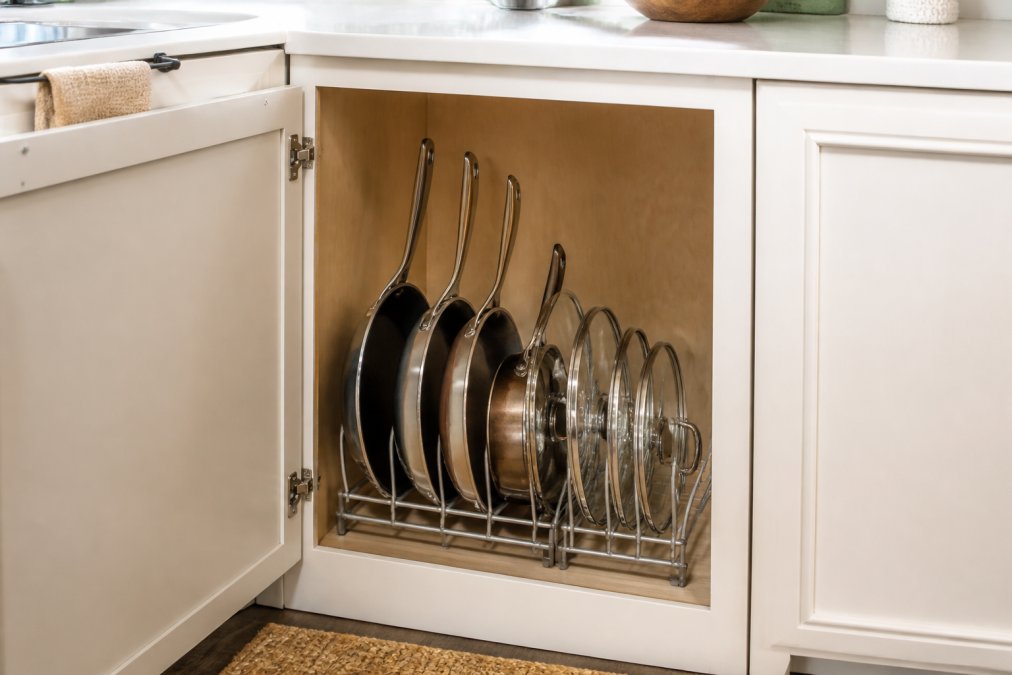
Stacking skillets nests them into scraped coatings and lid-hunting. Standing them on edge changes the math: you reach one pan without touching the others, and the cabinet's full depth works for you instead of hiding dead space.
A common mistake is buying a rack before measuring the cabinet. Interior depth, door clearance, and shelf height decide what fits, and most returns trace back to skipping that step.
Pots and Pans Organizer Rack: Types and Picks
The best pots and pans organizer rack depends on what you cook with most. Adjustable tier racks suit mixed collections, heavy-duty steel handles cast iron, and budget wire racks work for lightweight pans and lids.
| Rack Type | Best For | Watch Out For |
|---|---|---|
| Adjustable tier rack | Mixed pan sizes | Higher cost |
| Heavy-duty steel rack | Cast iron, Dutch ovens | Fixed slot widths |
| Wire rack | Light pans, lids, bakeware | Flexes under heavy loads |
| Corner rack | Small kitchens, dead corners | Corner placement only |
| Pull-out cabinet insert | Renovations, permanent setups | Needs installation |
Adjustable Tier Racks
Adjustable dividers matter most in a mixed kitchen. Sliding or repositionable dividers let you widen a slot for a deep sauté pan and narrow the next for a small saucepan, all in the same footprint.
The trade-off is cost: adjustable racks sit at the higher end, and the mechanism wears out first. Check that dividers lock firmly rather than sliding under load.
Heavy-Duty Racks for Cast Iron
Cast iron demands a rack rated for real weight, not slot count. Look for reinforced frames and rust-resistant finishes, because a loaded 12-inch skillet can outweigh three aluminum pans combined.
Skip wire racks here entirely. They flex, and a flexing rack drops pans. A fixed-slot heavy-duty rack is less versatile but far more stable.
Cabinet Dividers for Baking Sheets and Lids
Cabinet dividers for baking sheets turn a stack of sheet pans into a file of upright trays. The same principle handles lids, cutting boards, and muffin tins for far less than a full rack system.
Lids deserve their own divider rather than sharing slots with pans. A dedicated lid slot keeps glass from clattering against cast iron and lets you grab a lid without unloading the pan in front of it.
Two measurements decide fit: the widest sheet pan's width and the cabinet's interior depth. Standard sheet pans run wider than most people expect, so measure the pan, not the shelf.
DIY Vertical Pan Storage Ideas
DIY vertical pan storage ideas range from a tension rod in a cabinet to a wall-mounted rail, and most cost very little. The goal is the same: hold pans on edge, separated, at a reachable height.
Simple options that work:
- Tension rods across a cabinet opening create instant dividers for sheet pans and cutting boards.
- A pegboard panel on a wall or inside a cabinet door holds lightweight pans on hooks.
- Toe-kick drawers use the dead space under base cabinets for flat bakeware.
- A file-folder approach with coated wire dividers costs the least and installs in minutes.
- A wall rail with hooks clears cabinet space entirely for daily-use pans.
Permanent solutions like pull-out cabinet inserts cost more and require installation, but they glide out fully so nothing hides at the back.
Cabinet vs. Wall-Mounted vs. Countertop Storage
Cabinet storage protects cookware from grease and dust but hides it behind a door. Wall-mounted storage keeps pans visible and within reach, at the cost of wall space and drilling. Countertop racks need no installation and suit renters, but consume the surface you cook on.
| Location | Best For | Trade-Off |
|---|---|---|
| Inside cabinet | Dust protection, clean look | Less visible, door clearance needed |
| Wall-mounted | Daily-use pans, small kitchens | Requires drilling |
| Countertop | Renters, no-install setups | Uses prime counter space |
| Corner rack | Dead corner space | Limited placement |
For renters, a freestanding corner rack is usually the smartest pick: it uses dead space, needs no tools, and moves with you.
Materials, Weight Capacity, and Non-Stick Protection
Steel and coated wire dominate the category, but the coating and wire gauge matter more than the metal underneath. A non-scratch coating protects non-stick surfaces from the rack itself, the whole point of storing pans upright instead of nesting them.
| Material | Typical Load Behavior | Best For | Watch Out For |
|---|---|---|---|
| PVC- or vinyl-coated wire | Flexes under load; coating can crack at bends | Light non-stick pans, lids, bakeware | Coating peels over time; bare wire then scratches |
| Powder-coated steel | Rigid frame, rounded contact points | Mixed collections, daily use | Chips if dropped; rust at chips |
| Chrome-plated steel | Rigid, easy to wipe | Cast iron, Dutch ovens | Plating can flake in humid kitchens |
| Stainless steel | Rigid, rust-resistant, no coating to fail | Heavy cookware, long-term setups | Bare metal can scuff non-stick at contact points |
| Bamboo or wood | Light, warm look | Lids, cutting boards, light pans | Swells with moisture; not for cast iron |
Weight capacity is the spec most shoppers ignore. Racks are usually rated for a total distributed load, not a single slot, and a rack rated for light bakeware will bow under cast iron. A loaded 12-inch cast iron skillet commonly runs 8 to 10 pounds, and a 5-quart enameled Dutch oven often lands between 11 and 14 pounds, either can exceed the per-shelf rating of a wire rack sold for bakeware (Cast Iron Dutch Oven | Shop All Sizes Online). Match the rack's rating to your heaviest single piece plus a margin, not the average of everything you own.
Non-stick versus cast iron: two different storage problems
Non-stick pans are the delicate case. Bare wire can chip the coating at the contact point, and once a coating chips, the pan is done. Look for coated dividers, rounded or capped wire ends, and slots wide enough that the pan rests on its rim rather than its cooking surface. Felt or silicone edge protectors are a cheap fix for bare wire.
Cast iron and enameled cast iron are the opposite case.
Reading a weight rating before you buy
Maintenance, Cleaning, and Ergonomic Access
Cleaning coated wire and steel racks without ruining them
Ergonomic access and aging-in-place
Conclusion
Frequently Asked Questions
How do you store pots and pans vertically?
Stand pots and pans on their edges inside a cabinet using a vertical rack or adjustable dividers. Group by size so the largest pans sit at the back. For heavy cast iron, choose a reinforced rack rated for the weight. Keep lids in a separate divider or on the cabinet door to free up slot space. This vertical storage method typically frees up to half the shelf area compared to stacking.
Can you use vertical dividers for heavy cast iron skillets?
Yes, but the rack must be rated for the weight. Cast iron skillets can weigh 5 to 10 pounds each, so a lightweight wire rack may bend or tip. Look for heavy-duty racks with reinforced frames or a wall-mounted suspension rail. Place the heaviest pieces on the bottom tier and check the rack's weight capacity before loading it.
How do I keep baking sheets from falling over in the cabinet?
Use cabinet dividers for baking sheets, which are vertical slots that hold each sheet upright and separated. A simple wire divider or an adjustable tier rack works well. If you have a deep cabinet, place the dividers near the front so sheets stay reachable. Avoid leaning sheets against each other, as they slide and warp over time. A dedicated divider also prevents scratching non-stick coatings.
Are pull-out vertical organizers worth the investment?
Pull-out vertical organizers cost more than basic racks, but they make deep cabinets far easier to use. A full-extension pull-out brings every pan into view, so you stop digging behind stacks. They suit anyone with back or mobility concerns, and they protect non-stick surfaces from scraping. If you plan to stay in your home long term, the convenience usually justifies the higher price.
Vertical storage only pays off when the rack matches your cookware's weight and your kitchen's real dimensions. Viva homeStore offers a curated selection of practical home essentials focused on organization and functionality, from storage accessories to lighting and furniture, so you can clear the clutter and use the space you already have. Browse the collection and find the setup that fits your kitchen. Shop now.