

What Is Multifunctional Furniture for Apartments?
Table of Contents
- What Is Multifunctional Furniture for Apartments?
- Space-Saving Furniture Ideas That Actually Work in Small Apartments
- Convertible Furniture for Small Spaces: Sofa Beds, Modular Seating, and Hidden Storage
- How to Organize a Small Studio Apartment with Multifunctional Furniture
- Ergonomics, Assembly, and Maintenance: What Most Guides Skip
- Budget-Friendly DIY vs. High-End Investment and Smart Home Integration
- Frequently Asked Questions
Last Updated: September 16, 2026
What Is Multifunctional Furniture for Apartments?
Multifunctional furniture for apartments is any piece designed to serve two or more functions in a single footprint, such as a sofa that converts to a bed or a coffee table with lift-top storage. This guide breaks down how these pieces work, which types fit which rooms, and what to check before buying.
A studio might pack a bedroom, office, dining area, and living room into 400 square feet, so every piece must earn its place.
Core Features That Define Multifunctional Pieces
Three traits separate genuine multifunctional furniture from ordinary furniture with a marketing label.
- Dual-purpose design: The piece performs at least two distinct jobs. A storage ottoman seats a guest and holds bedding; a wall bed sleeps two and disappears by morning.
- Mechanical hardware: Hinges, gas struts, and folding mechanisms do the transforming, and quality hardware determines whether the piece still works smoothly after two years.
- Footprint efficiency: The piece occupies less floor area than the two items it replaces.
A common mistake is buying a "convertible" piece that transforms but is uncomfortable in both modes.
Space-Saving Furniture Ideas That Actually Work in Small Apartments
The most effective space-saving furniture ideas solve a specific problem in your floor plan rather than adding a generic gadget.
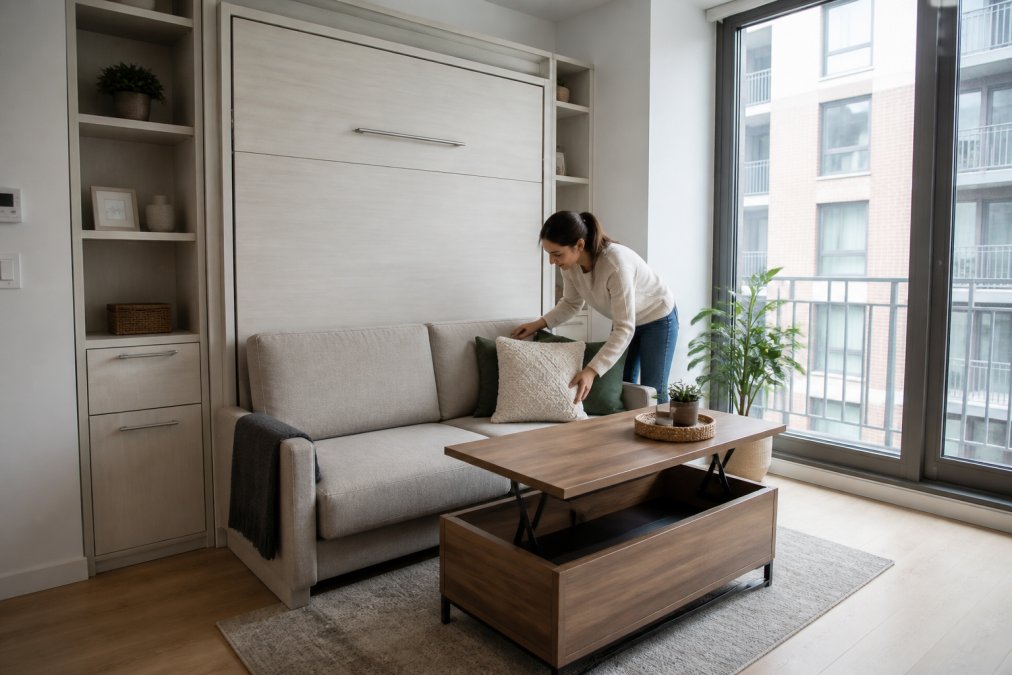
Wall Beds and Murphy Beds
Wall beds, often called Murphy beds, fold vertically into a wall-mounted cabinet and free the entire floor area of a bedroom during the day.
Transforming Dining and Coffee Tables
Lift-top coffee tables raise the tabletop to dining height and often hide storage underneath.
Convertible Furniture for Small Spaces: Sofa Beds, Modular Seating, and Hidden Storage
Convertible furniture for small spaces falls into three categories: sleeper sofas, modular seating, and pieces with built-in hidden storage.
Sofa Beds and Sleeper Sofas
A sleeper sofa hides a fold-out mattress inside the frame, while a sofa cum bed may use a simpler click-clack mechanism.
Modular Seating Arrangements
Modular seating lets you rearrange sections to fit the room instead of fitting the room to the sofa.
Hidden Storage Solutions
- Under-bed drawers on the main bed frame
- Lift-up sofa seats with internal compartments
- Ottoman storage for bedding and seasonal items
- Stair drawers if your unit has a split level
- Wall-mounted cabinets above doorways
How to Organize a Small Studio Apartment with Multifunctional Furniture
- Assign the bed or sleeper sofa to the darkest corner, away from the entry.
- Add a lift-top table that serves as both desk and dining surface.
- Use a storage ottoman as a coffee table and a seat for guests.
- Mount shelves above the desk to move clutter off the floor.
- Keep one clear walking path from door to window.
Ergonomics, Assembly, and Maintenance: What Most Guides Skip
Long-term comfort and upkeep decide whether multifunctional furniture was worth buying.
Long-Term Comfort and Ergonomic Design
- Sofa seat depth: 20 to 22 inches is the common comfort range for most adults. Under 18 inches feels perchy; over 24 inches forces shorter users to slide forward.
- Seat height: 17 to 19 inches from floor to top of cushion lets most adults sit with feet flat and knees near hip height.
- Back height: At least 28 inches from seat to top of backrest gives real lumbar and shoulder support. Low-back modular pieces look clean but tire you out on movie nights.
- Sleeper mattress thickness: 4.5 to 6 inches is typical for fold-out mattresses. Anything thinner than 4 inches tends to bottom out under an average adult within a year.
- Desk mode height: A lift-top table used as a desk should land between 28 and 30 inches. If the lift mechanism only reaches coffee-table height, it is not a real work surface.
Mechanical Hardware and Durability
What to inspect, and what tends to fail:
- Gas struts (wall beds, lift-top tables): These are pressurized cylinders that assist lifting. They typically lose charge gradually, so the piece gets heavier to lift before it stops holding position. Replaceable struts are a major plus; sealed, non-serviceable struts mean the whole mechanism may need replacing.
- Hinges and pivot points: Look for steel or heavy-gauge metal. Plastic hinges on a piece that folds daily are a short-lived part.
- Folding legs and locking mechanisms: A positive lock (a click or latch you can feel) is safer than friction-fit legs that can collapse under load.
- Frame material: Solid wood or metal frames outlast particleboard in high-stress convertible pieces. Particleboard is fine for a static shelf; it is a weak choice at a folding joint.
Assembly Complexity and Ongoing Care
- Every three months: Tighten all visible screws, bolts, and cam locks. Vibration from daily folding loosens hardware faster than most people realize.
- Every six months: Lubricate moving parts, hinges, pivot pins, and strut mounting points, with a dry silicone lubricant. Avoid oil-based lubricants, which attract dust and gum up over time.
- Annually: Inspect wall anchors and mounting plates on wall beds. Check that the bed's frame is still plumb against the wall.
- As needed: Vacuum the sleeper sofa mechanism to clear dust and debris from the folding arms. Debris is a common cause of stiff or jammed mechanisms.
- Always: Keep weight within the manufacturer's stated limits. Overloading a wall bed or lift-top table is the single fastest way to shorten its life.
| Piece Type | Typical Assembly | Ongoing Care | Watch For |
|---|---|---|---|
| Modular seating | Basic tools, 1-2 hours | Tighten connectors quarterly | Loose section joints |
| Sleeper sofa | Minimal, arrives assembled | Vacuum mechanism, check frame | Sagging mattress |
| Wall bed | Two people, wall anchoring | Lubricate struts, check anchors | Weak gas struts |
| Lift-top table | Basic tools, under 1 hour | Tighten hinge screws | Wobbly lift mechanism |
| Storage ottoman | None | Wipe clean, check lid hinges | Cracked lid supports |
Budget-Friendly DIY vs. High-End Investment and Smart Home Integration
Budget-friendly DIY options and high-end investment pieces both have a place, and the right choice depends on how long you plan to stay and how often the piece transforms.
The Cost-Per-Use Framework
A piece that folds twice a year and one that folds twice a day are not the same purchase, even at the same price.
What You Actually Get at Each Tier
- Entry tier: Particleboard frames, plastic or thin metal hinges, sealed non-replaceable struts, fabric that pills within a year of daily use. Fine for occasional use; frustrating for daily use.
- Mid tier: Engineered wood or mixed frames, metal hinges, replaceable struts on some models, better foam density in mattresses and cushions. This is the sweet spot for most apartments.
- High tier: Solid wood or welded metal frames, heavy-duty hardware rated for thousands of cycles, replaceable gas struts, higher-density foam, and finishes that resist wear at contact points.
Smart Home Integration: A Measured Look
Before buying a motorized piece, ask:
- Is there a manual override? If the answer is no, a power outage or a failed motor can leave the bed down or the table stuck in one position.
- Are the electronics serviceable? Motors, control boards, and wiring harnesses should be replaceable parts, not sealed into the frame.
- What is the warranty on the motor? Mechanical warranties often do not cover electronics. Check both.
- Do you actually need motorization? For most apartments, manual mechanisms remain the more reliable choice. Motorization earns its place when lifting force is a genuine barrier, for example, for someone with limited upper-body strength or a mobility limitation.
Frequently Asked Questions
What exactly is multifunctional furniture?
Multifunctional furniture is any piece designed to serve two or more purposes in a single footprint. A sofa bed works as seating during the day and a bed at night. A lift-top coffee table doubles as a dining surface or home office. The goal is to reduce the number of separate items you need, which frees up floor space and cuts clutter in compact apartments.
Can you give me some examples of multifunctional furniture?
Common examples include wall beds that fold into a cabinet, convertible sofa beds, nesting tables, storage ottomans, modular seating that reconfigures for guests, and dining tables that expand or drop to coffee-table height. Each piece replaces at least two standalone items, which matters most in studio apartments where every square foot counts.
Is multifunctional furniture expensive?
Pricing depends on materials, mechanical hardware, and brand. Basic foldable and nesting pieces cost less, while wall beds with quality lift mechanisms cost more. A useful approach is to compare the combined cost of the separate items a piece replaces, and you can find current pricing on specific products on our website.
How do you choose space-saving furniture for a small studio?
Start by measuring your floor plan and marking where you need to walk, sit, sleep, and store things. Then choose pieces that serve at least two of those needs. Prioritize items with durable mechanical hardware, check assembly requirements, and confirm the piece fits your space before buying. We carry options designed for small-scale living, and you can explore our selection to compare.
Choosing multifunctional furniture for apartments comes down to matching each piece to how you actually live, not to how a showroom displays it. Measure your space, test both functions, and check the hardware before you commit. Viva homeStore offers a curated selection of space-saving furniture, storage accessories, and lighting designed to help you get more from every square foot. Explore the collection and find pieces that fit your floor plan, your routine, and your budget. Shop now.